Roland Restaurant
Blk 89 Marine Parade Central, #06-750
Tel: +65 6440 8205
There are people for whom eating is a fad. For these people, it is important to keep up to date on the moving and shaking in the restaurant scene, and try the new restaurants as soon as they pop up. I, however, place myself squarely in the opposite camp. I like to search out the old restaurants – the ones that have been around for ages, the ones with tradition. In the restaurant business, time is the greatest arbiter of quality. You can’t keep customers coming back through good times and bad, if you didn’t put good food on the table. You just can’t. Don’t get me wrong: to suggest that just because a restaurant has been around for a while, their food will necessarily be spectacular is questionable logic at best. But you can’t go very wrong.
Roland Restaurant is one of those restaurants in Singapore that have pedigree up the wazoo – Chef Roland is from the family who used to run the famous Palm Beach Seafood Restaurant along Upper East Coast Road. This was back in the days when Upper East Coast Road was literally along the coast, before they reclaimed some land and built the ECP. Palm Beach was one of the several seafood places along that stretch, which all started from the same humble beginnings – in attap structures with zinc roofs, providing good food in mosquito-infested, “al fresco” settings. You have to drive down that stretch to get to my house, and I remember trundling down that road as a kid in the back of my dad’s beat up Datsun 1207. As I grew up, the restaurants slowly left one by one, to make way for condos and fancy residential developments. (The only one left standing today – Hua Yu Wee – is still going strong, in that beautiful colonial bungalow-on-stilts of theirs. I always mean to go back there, but the word on the street is that the quality has taken a tremendous dip, and so I am afraid of ruining my impression of the place.)
In any case, Palm Beach eventually closed for good, but Chef Roland eventually trained at the famous Sin Leong Restaurant. When Chef Sin Leong decided to hang up his wok, he left the restaurant to his disciple, who renamed it after himself. To this day, they are in the same, quirky location – at the top floor of a multi-storey carpark in Marine Parade.
If being the progeny of two famous franchises isn’t enough, consider these additional titbits: the family that ran Palm Beach Seafood is widely credited with inventing chilli crab – a dish that has now achieved ubiquitous, “national dish” status in Singapore. Also, Chef Sin Leong, Chef Roland’s mentor, was one of the four “heavenly kings” of the culinary world back then who created yusheng – the raw fish dish that is a must at Chinese New Year dinners now. Put all this together, and it is like saying Roland Restaurant is like Man O’War, Citation, Secretariat and Ruffian all rolled into one. I struggle to think of another franchise with as much pedigree as this one.
In any case, we got together for Sophia’s farewell the other day, and it fell to me to suggest a place. I hadn’t come back here in ages and, unsure of the quality, was a little hesitant about recommending it. But after considering the other options for good crabs in the East, there didn’t seem to be many other options: Eng Seng would have sold out by the time we got there, the seafood stretch at East Coast Park was a little difficult for everyone else to get to, and No Signboard at Geylang was in a pretty dodgy area. It was a good thing that Sophia seconded the suggestion, but she also cautioned that the place was sometimes hit-and-miss.
It might literally have been twenty years since I last visited the restaurant, and upon walking in I had no recollection of how it used to look like or how it had changed. What it does look like now is your standard banquet-style Chinese restaurant. For a Friday evening, it was surprisingly empty – apart from us there were only about six or seven other tables, and the restaurant was less than half full. I did a double take – surely this was not a good sign?
I needn’t have worried, because the food that Roland puts out is still – and I hate to use such a cliché but it is rather appropriate while eating crabs – finger-licking good. Roland has amassed a small array of signature dishes – culled from the history of Palm Beach and Sin Leong, and these do not disappoint. The prawns in soy sauce were succulent and flavoured well, while the braised pork ribs melted off the bone. Deep-fried you tiao came crispy and had good volume, without being too oily; and the sambal watercress was strangely addictive. The Peking duck was a little dry, and perhaps the most lacklustre of the dishes, but by then the kitchen had earned a reprieve.
And the crabs – who could forget the crabs? We ordered them two ways: in their signature chilli sauce as well as in a salted egg batter. Now, chilli crab may be a national dish, but it is one of those things that have as many variants as chefs, and nobody can agree on what the truly definitive version is. Some make it sweet, some make it spicy; some add crab roe, others add egg. Roland’s version was very good and had impressive amounts of crab roe – which I liked – but may have been a little too sweet for me, and definitely not spicy enough. The salted egg treatment was also, unfortunately, quite mediocre. The crabs themselves were meaty and fresh, though, so say what you will, but those dishes still disappeared in a flash. Li Jade was thoughtful enough to stop by even though she had eaten already – but she was unfortunate enough to arrive just as the crabs were served, so nobody paid her any attention.
Obviously, the best part of eating crabs is getting to dip mantous into the sauce and slurp it up. Roland’s mantous are bite-sized, which make them easier to handle with chopsticks, and also easier to polish off. I lost count of how many of those little buggers I ate, and by the end of the meal the serving dish with the chilli sauce was absolutely spotless.
The highlight of my night was the fried seafood mee sua at the end of the meal, to fill whatever empty spaces in the stomach you could possibly have after eight or nine courses of protein. It was fried well, had good, understated, nuanced flavour – and the noodles were very tasty.
We were there for quite a while – during what we thought would have been a peak hour – but the crowd never got larger. I felt a little sad for this bastion of the culinary scene. They’re still around, so they can’t be doing too badly, but I can’t help but feel that all the new restaurants popping up are dealing significant blows to the old ones.
My opinion may be coloured by nostalgia and love of tradition, but it isn’t too coloured that I cannot admit – Roland is not amazing. They will, sadly, not blow you away. The signature dishes are very good and very honest, but they are clearly not one of the big boys in the restaurant scene any more. From a subjective standpoint, I like Roland, and would go back in a heartbeat – because the food is satisfying and good value for money. But from an objective, professional standpoint – the place lacks the exquisite treatments of the finer restaurants around, and the oomph of the better tze char places.
As the demography of Singaporeans changes, and their tastes along with it, Roland is slowly but surely becoming outmoded. You and I from a certain generation may still appreciate their signature dishes, and the way they cook these dishes, but sooner or later more and more will beg to differ. It’s like watching Roger Federer play tennis now. He is still a wonderful player, but no longer the best, and try as he might it is only a matter of time before he is surpassed by more and more up-and-coming players. Watching him play is only going to get more and more painful for his fans – maybe not now, but surely in two or three years’ time, if he plays on for that long. The only question is – how much longer can he, and Roland Restaurant, continue to trade on their pedigree?
Sunday, July 18, 2010


Wednesday, July 07, 2010
Walking in the Garden
Au Jardin Les Amis
1 Cluny Road
EJH Corner House, Botanic Gardens
Tel: +65 6466 8812
A very good friend of mine once said about women, “You can’t live with them, and you can’t kill them.” I think that must be how chefs think about events – corporate luncheons or dinners, weddings, rehearsals, what-have-you. For these events. chefs often have to cede some measure of creative control over the menu, and they can be quite taxing on the kitchen because large orders of the same dish have to go out all at the same time. Yet they are a necessary evil, especially for restaurants with little walk-in traffic, and on slow weeknights. You have to do them to survive.
This is especially the case for Au Jardin, at the Botanic Gardens. It is a Les Amis restaurant, which means it comes from pedigree. (To explain, Les Amis at Shaw Tower is the grande dame of Singapore fine dining, akin to a Tour D’Argent in Paris or Le Cirque in New York: it’s been around for ages and by this point is surely more institution than restaurant. Whether or not the food is good is no longer relevant.) But Au Jardin (French for “in the garden”), one of their sister restaurants, is also tucked away in the deep recesses of the Botanic Gardens, in an old colonial bungalow surrounded by lush, well-manicured greenery. Needless to say, there is little to no pedestrian footfall, unless you count joggers and bird-watchers. In a sense it is more a “destination” restaurant than anything – everyone who eats there has made a pre-meditated decision to do so. So since it’s pretty far from likely than a random jogger is going to walk into Au Jardin after his run and ask for the degustation, doing events is an absolute must.
I went for an event at Au Jardin last evening (and in the process turned down an invitation from Karen to eat beef hor fun at Kim Moh, shucks). The whole converted pre-war colonial bungalow in the middle of nowhere concept has been done before (and failed before – see Alkaff Mansion, and that other famous restaurant that was in one of the old black and white bungalows along Scotts Road, but whose name escapes me). Au Jardin hews closely to the successes of these illustrious forebears. Stately teak-on-whitewash, little ornamentation, as much natural light as possible – all great things, and all make for a wonderful setting. It’s a little formulaic, but by no means unenjoyable.
It is always a tough thing organizing events over dinner. Do you have your speeches or presentations before, during or after dinner? If you have them before dinner, people get hungry and restless. If you have them during dinner, nobody pays attention. And people tend to leave once they are fed, so you can’t have them after dinner. It’s a no-win situation. Some people do the events in between courses, but that isn’t optimal either. Unfortunately, I haven’t been to an event where this has been handled gracefully, and I don’t have any ideas. It’s a tough one, this.
The food at Au Jardin was not bad, but ultimately quite disappointing. This was not the French cooking of bars and bistros, with their heavy sauces and their often lengthy, complicated processes. This was supposedly refined French cooking, with light touches and innovative flavour pairings. And one cannot fault them for trying, I suppose. All three courses – two appetizers and a main – were well thought through, not overly complicated, and promised fine ingredients. Lobster salad with vine-ripe tomato. Seared Hokkaido sea scallop with poached egg in a truffle emulsion. Wagyu beef filet. But the thing about cooking like this is that it demands quality, fresh ingredients. I assume the sea scallop was really from Hokkaido. Now I don’t doubt that if you eat sea scallop in Hokkaido, it might be a life-changing experience. But once that sea scallop is chilled, air-freighted, and transported to Singapore – travelling thousands of miles and changing hands several times – it loses a lot of what is good and great about it. The scallop I wound up eating in the Botanic Gardens of Singapore was cooked precisely, and flavoured well, but it paled in comparison to some of the fresh seafood I have had in the past.
(Side note: I don’t know where the Wagyu beef was from. These days the term is bandied about so casually, who knows what you are getting any more? But I do know that it cannot have been from Japan, since Japanese beef imports to Singapore have been suspended since late April, due to an outbreak of foot-and-mouth disease at a cattle farm in Japan’s Miyazaki Prefecture. In any case the beef that I wound up having was a long way short of Wagyu beef standards, and for some reason looked deceptively blood-red. I think they poured some of the juices on top of the filet to make it look red, but when I actually bit into it, it was a lot less rare than it looked. A very strange phenomenon.)
The other thing I noticed about Au Jardin was the uncannily stealthy, almost ninja-like efficiency of the waitstaff. Plates were whisked away, drinks refilled, cutlery replaced – all wordlessly and unnoticeably. I don’t know if this is a good thing – sometimes I like a little banter with my waitress (especially if she’s cute). At Au Jardin you strangely get none of that – all the waitstaff are trained to remain silent and expressionless, and to go about their duties speedily and with no fuss.
I don’t know if I would go back to Au Jardin (especially after looking at their prices online). I have no doubt of the chef’s talent, and their cuisine is one that I enjoy. It’s just that for their cuisine to work, fresh ingredients are paramount. And in Singapore – that is a little difficult. It’s still a very enjoyable place to sit down and have a meal though, and you really feel cut off from civilization even though Orchard Road is only two minutes away. I suppose it’s a good place to impress someone with, but the more discerning of companions will be able to see that you’re trying too hard.
1 Cluny Road
EJH Corner House, Botanic Gardens
Tel: +65 6466 8812
A very good friend of mine once said about women, “You can’t live with them, and you can’t kill them.” I think that must be how chefs think about events – corporate luncheons or dinners, weddings, rehearsals, what-have-you. For these events. chefs often have to cede some measure of creative control over the menu, and they can be quite taxing on the kitchen because large orders of the same dish have to go out all at the same time. Yet they are a necessary evil, especially for restaurants with little walk-in traffic, and on slow weeknights. You have to do them to survive.
This is especially the case for Au Jardin, at the Botanic Gardens. It is a Les Amis restaurant, which means it comes from pedigree. (To explain, Les Amis at Shaw Tower is the grande dame of Singapore fine dining, akin to a Tour D’Argent in Paris or Le Cirque in New York: it’s been around for ages and by this point is surely more institution than restaurant. Whether or not the food is good is no longer relevant.) But Au Jardin (French for “in the garden”), one of their sister restaurants, is also tucked away in the deep recesses of the Botanic Gardens, in an old colonial bungalow surrounded by lush, well-manicured greenery. Needless to say, there is little to no pedestrian footfall, unless you count joggers and bird-watchers. In a sense it is more a “destination” restaurant than anything – everyone who eats there has made a pre-meditated decision to do so. So since it’s pretty far from likely than a random jogger is going to walk into Au Jardin after his run and ask for the degustation, doing events is an absolute must.
I went for an event at Au Jardin last evening (and in the process turned down an invitation from Karen to eat beef hor fun at Kim Moh, shucks). The whole converted pre-war colonial bungalow in the middle of nowhere concept has been done before (and failed before – see Alkaff Mansion, and that other famous restaurant that was in one of the old black and white bungalows along Scotts Road, but whose name escapes me). Au Jardin hews closely to the successes of these illustrious forebears. Stately teak-on-whitewash, little ornamentation, as much natural light as possible – all great things, and all make for a wonderful setting. It’s a little formulaic, but by no means unenjoyable.
It is always a tough thing organizing events over dinner. Do you have your speeches or presentations before, during or after dinner? If you have them before dinner, people get hungry and restless. If you have them during dinner, nobody pays attention. And people tend to leave once they are fed, so you can’t have them after dinner. It’s a no-win situation. Some people do the events in between courses, but that isn’t optimal either. Unfortunately, I haven’t been to an event where this has been handled gracefully, and I don’t have any ideas. It’s a tough one, this.
The food at Au Jardin was not bad, but ultimately quite disappointing. This was not the French cooking of bars and bistros, with their heavy sauces and their often lengthy, complicated processes. This was supposedly refined French cooking, with light touches and innovative flavour pairings. And one cannot fault them for trying, I suppose. All three courses – two appetizers and a main – were well thought through, not overly complicated, and promised fine ingredients. Lobster salad with vine-ripe tomato. Seared Hokkaido sea scallop with poached egg in a truffle emulsion. Wagyu beef filet. But the thing about cooking like this is that it demands quality, fresh ingredients. I assume the sea scallop was really from Hokkaido. Now I don’t doubt that if you eat sea scallop in Hokkaido, it might be a life-changing experience. But once that sea scallop is chilled, air-freighted, and transported to Singapore – travelling thousands of miles and changing hands several times – it loses a lot of what is good and great about it. The scallop I wound up eating in the Botanic Gardens of Singapore was cooked precisely, and flavoured well, but it paled in comparison to some of the fresh seafood I have had in the past.
(Side note: I don’t know where the Wagyu beef was from. These days the term is bandied about so casually, who knows what you are getting any more? But I do know that it cannot have been from Japan, since Japanese beef imports to Singapore have been suspended since late April, due to an outbreak of foot-and-mouth disease at a cattle farm in Japan’s Miyazaki Prefecture. In any case the beef that I wound up having was a long way short of Wagyu beef standards, and for some reason looked deceptively blood-red. I think they poured some of the juices on top of the filet to make it look red, but when I actually bit into it, it was a lot less rare than it looked. A very strange phenomenon.)
The other thing I noticed about Au Jardin was the uncannily stealthy, almost ninja-like efficiency of the waitstaff. Plates were whisked away, drinks refilled, cutlery replaced – all wordlessly and unnoticeably. I don’t know if this is a good thing – sometimes I like a little banter with my waitress (especially if she’s cute). At Au Jardin you strangely get none of that – all the waitstaff are trained to remain silent and expressionless, and to go about their duties speedily and with no fuss.
I don’t know if I would go back to Au Jardin (especially after looking at their prices online). I have no doubt of the chef’s talent, and their cuisine is one that I enjoy. It’s just that for their cuisine to work, fresh ingredients are paramount. And in Singapore – that is a little difficult. It’s still a very enjoyable place to sit down and have a meal though, and you really feel cut off from civilization even though Orchard Road is only two minutes away. I suppose it’s a good place to impress someone with, but the more discerning of companions will be able to see that you’re trying too hard.
Monday, June 28, 2010
So long, for now
Pavilion Restaurant
20 Craig Road
#01-02, Craig Place
Tel: +65 6557 2820
There are very few things I am willing to wake up early on Sunday mornings for. One of them is the practice of yum cha – going to restaurants and eating dim sum. I absolutely love doing this. Sometimes it seems that weekends wind up being busier than weekdays are – with one commitment after the other. Going for a nice leisurely dim sum brunch relaxes the mind and body like nothing else, and it is one of my favourite activities.
I got back from Sri Lanka Sunday morning at 8am after a red-eye, and any other reasonable person would have headed straight home for a deserved forty (or eighty) winks. But Victor had organised a brunch – to be his farewell before he leaves for Taiwan for a year – and it was one I could not miss. I headed home to shower and managed to close my eyes for an hour or so before it was time to head out again.
(Besides, he was buying, and I am cheap like that.)
Victor is one of my trusted foodie friends and eating kakis, and can always be counted on for good judgment when it comes to all things gastronomic. Our tastes are also quite similar in that we have an unabashed love of hawker food, and when it comes to restaurant dining we tend to prefer classical Chinese cuisine, with its soups and roasted meats. His departure may have meant just one less person in my network of scouts, but one who was a significant contributor. His presence will be missed.
He deferred to me for a choice of restaurant, and I suggested Pavilion. I had heard about it a little while ago from an acquaintance – and had wanted to wait till it had been open more than four or five months before trying it. Victor’s farewell came at just about the right time, and he was gracious enough to acquiesce to the suggestion – so off we were!
Pavilion is situated in an area with quite a bit of character, the Duxton/Keong Saik area, just a few doors down from Pasta Brava. It is pretty interesting coming here for dim sum on a Sunday because nothing else in the area – littered with bars and shady KTV pubs – is open at the time. Add that to the fact that it is smack on the fringes of the Central Business District – desolated on Sundays – and you have a restaurant that is bathed in an eerie calm as we approach it.

The inside was just as empty as the streets outside were, and for a minute we did a double-take, wondering if we were at the right place. But the restaurant soon filled up, and through our meal we saw a procession of families, groups of foodie friends – young and old alike – come and go. The clientele was decidedly eclectic, and it had the feel of a restaurant that had not come into its own yet, still finding its own gaggle of regulars.
The food surprised and spluttered in equal measure, alternating between the sublime and the shoddy. We started out really strong, with a cold dish of homemade beancurd with red cherry shrimp and century egg completely knocking me off my feet. I didn’t bother taking a photo of this since it was not much to look at, but one taste and I was reminded not to judge a book by its cover. The beancurd was soft and silky, and topped with a sauce made from century egg – so imagine white slabs covered in a gooey greenish-brown sauce. It didn’t look very appetising, but it was quite stellar.

Compared to the version at Victoria Peak, the siu yoke was at least cubed in sizeable portions, and paired with a decent Dijon. We also had a soup of crab meat and fish maw, which was very well executed. I don’t know why, and it may be just me, but restaurants never put enough pepper and vinegar in their soups. You may think it’s a personal taste thing, but I have never seen anyone drink soup from a Chinese restaurant without adding to taste. We all do it. It’s never seasoned enough when it comes out of the kitchen. Why wouldn’t chefs just adjust, and season the soups a little more? Perhaps it has now become a psychological mind-game, and chefs deliberately under-season the soups because they know diners will adjust it themselves anyway.


The dim sum dishes that we ordered were very impressive. I have to say Pavilion goes all out for some of these. Their siew mai was larger than any other version I’ve seen, and had large pieces of scallop in them – an appreciated twist. In contrast, the liu sha bao was tiny – the size of a golf ball – and despite the custard not being runny enough for my liking, was a very creditable effort. The deep fried spring rolls tasted rather ordinary, but at least didn’t taste oily or greasy.


It is right about here that the meal went downhill. We had ordered a set menu – at $78++ a very reasonably priced dim sum set menu for 4 – and rounding out the dim sum was a trio of “normal” dishes. The steamed kailan with beancurd and mei cai (preserved vegetables) was just passable, saved by the burst of umami that the mei cai gave the dish. The belly-rib “Zheng Jiang” style was battered and deep fried well, but somehow the taste just didn’t agree with me. This could be just a personal thing, for Daselin had many good things to say about the dish.


But what was severely disappointing was the wok-fried hor fun with pork and chye poh. Dry, dreary in colour, and lacking in wok hei, it really almost felt like an amateur had cooked it. There was nothing bringing together the dish, no harmony of flavours, no cohesion. By themselves, these are very cheap ingredients – rice flour noodles, strips of pork, and chye poh – and it really felt like it. I could only take two spoonfuls before I had to push the bowl away. Victor polished his bowl and joked that he didn’t like to waste food, but shook his head in disgust when I offered him the rest of my bowl to finish off.
The hor fun reinforced my innate distrust of set menus. Very often, restaurants will offer their star dishes as part of a set menu, but the line-up will invariably be rounded out with other disappointing dishes, or dishes on which they make the highest margins. At Chinese restaurants, you are almost always better off ordering a la carte.
Dessert was similarly uninspiring – two servings of tofu ice cream topped with a sesame and a lychee syrup. This place seems to really like the soybean, by the way.
Despite all that, I actually rather liked Pavilion. It is nice and cosy, and that first beancurd dish won them enough brownie points to forgive one or two misses. (Not the hor fun though, nothing can excuse that.) The service staff was efficient and attentive, and kind enough to let us stay long after the lunch hours – filling our teacups without asking.
So it is goodbye for now for Victor, and as we eventually trudged off from the restaurant there was a little sadness lingering. But we took comfort in two things: knowing that he would be back, and the fact that he could unearth more good eats in Taiwan. Consider this his overseas scouting mission, then!
20 Craig Road
#01-02, Craig Place
Tel: +65 6557 2820
There are very few things I am willing to wake up early on Sunday mornings for. One of them is the practice of yum cha – going to restaurants and eating dim sum. I absolutely love doing this. Sometimes it seems that weekends wind up being busier than weekdays are – with one commitment after the other. Going for a nice leisurely dim sum brunch relaxes the mind and body like nothing else, and it is one of my favourite activities.
I got back from Sri Lanka Sunday morning at 8am after a red-eye, and any other reasonable person would have headed straight home for a deserved forty (or eighty) winks. But Victor had organised a brunch – to be his farewell before he leaves for Taiwan for a year – and it was one I could not miss. I headed home to shower and managed to close my eyes for an hour or so before it was time to head out again.
(Besides, he was buying, and I am cheap like that.)
Victor is one of my trusted foodie friends and eating kakis, and can always be counted on for good judgment when it comes to all things gastronomic. Our tastes are also quite similar in that we have an unabashed love of hawker food, and when it comes to restaurant dining we tend to prefer classical Chinese cuisine, with its soups and roasted meats. His departure may have meant just one less person in my network of scouts, but one who was a significant contributor. His presence will be missed.
He deferred to me for a choice of restaurant, and I suggested Pavilion. I had heard about it a little while ago from an acquaintance – and had wanted to wait till it had been open more than four or five months before trying it. Victor’s farewell came at just about the right time, and he was gracious enough to acquiesce to the suggestion – so off we were!
Pavilion is situated in an area with quite a bit of character, the Duxton/Keong Saik area, just a few doors down from Pasta Brava. It is pretty interesting coming here for dim sum on a Sunday because nothing else in the area – littered with bars and shady KTV pubs – is open at the time. Add that to the fact that it is smack on the fringes of the Central Business District – desolated on Sundays – and you have a restaurant that is bathed in an eerie calm as we approach it.

The inside was just as empty as the streets outside were, and for a minute we did a double-take, wondering if we were at the right place. But the restaurant soon filled up, and through our meal we saw a procession of families, groups of foodie friends – young and old alike – come and go. The clientele was decidedly eclectic, and it had the feel of a restaurant that had not come into its own yet, still finding its own gaggle of regulars.
The food surprised and spluttered in equal measure, alternating between the sublime and the shoddy. We started out really strong, with a cold dish of homemade beancurd with red cherry shrimp and century egg completely knocking me off my feet. I didn’t bother taking a photo of this since it was not much to look at, but one taste and I was reminded not to judge a book by its cover. The beancurd was soft and silky, and topped with a sauce made from century egg – so imagine white slabs covered in a gooey greenish-brown sauce. It didn’t look very appetising, but it was quite stellar.

Compared to the version at Victoria Peak, the siu yoke was at least cubed in sizeable portions, and paired with a decent Dijon. We also had a soup of crab meat and fish maw, which was very well executed. I don’t know why, and it may be just me, but restaurants never put enough pepper and vinegar in their soups. You may think it’s a personal taste thing, but I have never seen anyone drink soup from a Chinese restaurant without adding to taste. We all do it. It’s never seasoned enough when it comes out of the kitchen. Why wouldn’t chefs just adjust, and season the soups a little more? Perhaps it has now become a psychological mind-game, and chefs deliberately under-season the soups because they know diners will adjust it themselves anyway.


The dim sum dishes that we ordered were very impressive. I have to say Pavilion goes all out for some of these. Their siew mai was larger than any other version I’ve seen, and had large pieces of scallop in them – an appreciated twist. In contrast, the liu sha bao was tiny – the size of a golf ball – and despite the custard not being runny enough for my liking, was a very creditable effort. The deep fried spring rolls tasted rather ordinary, but at least didn’t taste oily or greasy.


It is right about here that the meal went downhill. We had ordered a set menu – at $78++ a very reasonably priced dim sum set menu for 4 – and rounding out the dim sum was a trio of “normal” dishes. The steamed kailan with beancurd and mei cai (preserved vegetables) was just passable, saved by the burst of umami that the mei cai gave the dish. The belly-rib “Zheng Jiang” style was battered and deep fried well, but somehow the taste just didn’t agree with me. This could be just a personal thing, for Daselin had many good things to say about the dish.


But what was severely disappointing was the wok-fried hor fun with pork and chye poh. Dry, dreary in colour, and lacking in wok hei, it really almost felt like an amateur had cooked it. There was nothing bringing together the dish, no harmony of flavours, no cohesion. By themselves, these are very cheap ingredients – rice flour noodles, strips of pork, and chye poh – and it really felt like it. I could only take two spoonfuls before I had to push the bowl away. Victor polished his bowl and joked that he didn’t like to waste food, but shook his head in disgust when I offered him the rest of my bowl to finish off.
The hor fun reinforced my innate distrust of set menus. Very often, restaurants will offer their star dishes as part of a set menu, but the line-up will invariably be rounded out with other disappointing dishes, or dishes on which they make the highest margins. At Chinese restaurants, you are almost always better off ordering a la carte.
Dessert was similarly uninspiring – two servings of tofu ice cream topped with a sesame and a lychee syrup. This place seems to really like the soybean, by the way.
Despite all that, I actually rather liked Pavilion. It is nice and cosy, and that first beancurd dish won them enough brownie points to forgive one or two misses. (Not the hor fun though, nothing can excuse that.) The service staff was efficient and attentive, and kind enough to let us stay long after the lunch hours – filling our teacups without asking.
So it is goodbye for now for Victor, and as we eventually trudged off from the restaurant there was a little sadness lingering. But we took comfort in two things: knowing that he would be back, and the fact that he could unearth more good eats in Taiwan. Consider this his overseas scouting mission, then!
Sunday, June 27, 2010
Floored by fruit
One of the biggest drags for serious foodies in Singapore is the lack of fresh produce. Singapore grows less than 5% of the food it consumes, and land is so scarce that it is typically allocated to other uses than food production. Even though the agricultural parts of Malaysia may only be a few hours' drive away, something like a Blue Hill would still be next to impossible here.
I was reminded of this during a recent trip to Sri Lanka, where I was served a piece of papaya as part of breakfast. The papaya did not look all that appetising: veiny and overripe in parts while underripe in others, and I almost pushed the plate aside before something in me clicked. It may be the guilt from having too little fibre in my diet, but something made me pick up that spoon and carve myself a bite of that papaya.

Boy am I glad I did, because it was juicy, succulent and sweet beyond belief. I realised just how much eating fruit in Singapore had dulled me to the heights that fresh fruit can scale. The fruit we get in Singapore is almost always grown elsewhere, picked before it is ripe and sprayed with chemicals to retard ripening and kill pests, before it is transported here. I had forgotten just how sweet and wonderful a piece of fruit, picked when ripe and eaten within a day or two – or even hours – could be. This piece of papaya was a timely reminder.
I was reminded of this during a recent trip to Sri Lanka, where I was served a piece of papaya as part of breakfast. The papaya did not look all that appetising: veiny and overripe in parts while underripe in others, and I almost pushed the plate aside before something in me clicked. It may be the guilt from having too little fibre in my diet, but something made me pick up that spoon and carve myself a bite of that papaya.

Boy am I glad I did, because it was juicy, succulent and sweet beyond belief. I realised just how much eating fruit in Singapore had dulled me to the heights that fresh fruit can scale. The fruit we get in Singapore is almost always grown elsewhere, picked before it is ripe and sprayed with chemicals to retard ripening and kill pests, before it is transported here. I had forgotten just how sweet and wonderful a piece of fruit, picked when ripe and eaten within a day or two – or even hours – could be. This piece of papaya was a timely reminder.
Friday, June 18, 2010
The wisdom of crowds
Two Chefs
Blk 116 Commonwealth Crescent #01-129
Tel: +65 6472 5361
These days, the ease of expressing one’s opinion via a variety of media online has made the views of crowds instantly accessible. There is just one thing wrong with this: the crowds may not always be right. There is a site called hungrygowhere.com which serves as an aggregator of reviews on eating places in Singapore. Now, there are many good things about this site which I like. It is very comprehensive, and can normally be counted on to provide good, up-to-date information on all manner of establishments – from the one-man-operated kiosks to the hundred-seater banquet halls. I have to say that I post my reviews there sometimes (I want to be heard too you know, I believe I am entitled to that conceit). Yet I have found myself disagreeing many times with the collective opinions of certain places, and so when push comes to shove I am inclined not to trust this site.
I still believe in the masses’ general tendency towards accuracy – as in, the collective opinion more often than not points in the right direction, good or bad. But it is a blunt instrument, and cannot provide the level of precision serious foodies need. There is a world of difference between great and good, between divine and satisfactory, and that precision is lost when truly discerning opinions get mixed in with a whole bunch of others that are not so.
One of the dangers of this “crowdsourcing” is the tendency for aggregation to amplify certain attributes. It is human nature to want to know the opinion of others, and human nature for those opinions to subtly influence our own. If we read other reviews that echo our own opinions, we subliminally reinforce, and in some cases intensify, our own impressions of the place. In that way, what was maybe a decent-to-good, two-star restaurant at best, suddenly gets elevated to a three-star.
But as the saying goes, two heads are better than one, and that may be the rationale behind this stalwart of the tze char scene in Singapore. Two Chefs is actually opened by a pair of brothers, who have come together to bring you this no-frills, salt-of-the-earth eating place in the Commonwealth area. So far, and to my knowledge at least, they have not gone the way of countless other family businesses or hawker dynasties, and the two brothers look to be doing quite well together. I’ve heard that lines start forming by 6pm for dinner, and the wait for a place can hit the 45-minute or 1-hour mark. For good, simple, tze char comfort food – that is a long wait.
Two Chefs is an undisputed media and blogosphere darling. Almost every online review of it is generous to a fault, and the place was lauded by the Sunday Times as one of the best tze char places in Singapore. I rarely venture out of the East for food, so until recently had not had the good fortune to try it. But it was recently suggested as a venue for a midweek get-together, and despite there being other, more familiar names tossed in the hat – I plumped for this one just to check it out.
I was quite disappointed, for the food was very average. The one dish that everyone goes there for is the butter pork ribs, which are cutlets of pork breaded and deep-fried, and then coated with a powdery mixture that looks like grated parmesan cheese but is actually a secret formulation made from butter and sugar. This was not bad, I have to say, for the meat was tender and moist, and the buttery powder neither overly sweet nor cloying. But while it won high marks from me for innovation, it didn’t quite deserve the unadulterated adulation of the blogging community.
Other dishes were downright disappointing. The kailan hadn’t been blanched before wok-frying, and so retained a bitter pang. The tofu with golden mushroom wasn’t top-grade tofu, and the sauce tasted a little off. The drunken “dang gui” prawns were large and succulent, granted, but the Shaoxing broth it was in lacked oomph, and could perhaps have been rounded out with a fuller ingredient base.
We were so unimpressed by the quality (and quantity) of the food that we had to order a couple more dishes. To satisfy someone’s craving we got another treatment of pork ribs – this time a coffee pork ribs which was surprisingly good. But the three-egg vegetables that we got on the waitress’ recommendation only served to confirm that either this place was terrible, or the kitchen was having an off day. There is an art to cooking vegetables, for most leafy greens have little, or in some cases even unpleasant, flavour. Many cooks – in addition to their other seasonings – typically add a little sugar to the wok as the vegetables are cooking, which helps them to caramelize and adds both flavour and texture. This did not seem to have been done for the three-egg vegetables.
I do have to mention that the food came unbelievably fast. It felt as though we had only just finished ordering when the first dish came out the pass and was placed on our table. My hypothesis is that the kitchen – used to dealing with a full house on weekends – is such a well-oiled machine that cooking for a crowd of 60-or-70-percent capacity is a piece of cake for them. If that is true, then it is cause for admiration.
I really wanted to like this place. The heartland location, the utilitarian setup. The lack of pretensions, the honest fare. These are all good things, and true things. I tried to disassociate my appreciation of the place from what I had heard about it, to ensure objectivity and while true objectivity is perhaps impossible, I honestly did not think this place was all that great. It is not that it is bad, and I would be happy to go back there again since it is relatively affordable. But it is just not praise-worthy. I am sorry to say, the wisdom of the masses got it wrong on this one.
Blk 116 Commonwealth Crescent #01-129
Tel: +65 6472 5361
These days, the ease of expressing one’s opinion via a variety of media online has made the views of crowds instantly accessible. There is just one thing wrong with this: the crowds may not always be right. There is a site called hungrygowhere.com which serves as an aggregator of reviews on eating places in Singapore. Now, there are many good things about this site which I like. It is very comprehensive, and can normally be counted on to provide good, up-to-date information on all manner of establishments – from the one-man-operated kiosks to the hundred-seater banquet halls. I have to say that I post my reviews there sometimes (I want to be heard too you know, I believe I am entitled to that conceit). Yet I have found myself disagreeing many times with the collective opinions of certain places, and so when push comes to shove I am inclined not to trust this site.
I still believe in the masses’ general tendency towards accuracy – as in, the collective opinion more often than not points in the right direction, good or bad. But it is a blunt instrument, and cannot provide the level of precision serious foodies need. There is a world of difference between great and good, between divine and satisfactory, and that precision is lost when truly discerning opinions get mixed in with a whole bunch of others that are not so.
One of the dangers of this “crowdsourcing” is the tendency for aggregation to amplify certain attributes. It is human nature to want to know the opinion of others, and human nature for those opinions to subtly influence our own. If we read other reviews that echo our own opinions, we subliminally reinforce, and in some cases intensify, our own impressions of the place. In that way, what was maybe a decent-to-good, two-star restaurant at best, suddenly gets elevated to a three-star.
But as the saying goes, two heads are better than one, and that may be the rationale behind this stalwart of the tze char scene in Singapore. Two Chefs is actually opened by a pair of brothers, who have come together to bring you this no-frills, salt-of-the-earth eating place in the Commonwealth area. So far, and to my knowledge at least, they have not gone the way of countless other family businesses or hawker dynasties, and the two brothers look to be doing quite well together. I’ve heard that lines start forming by 6pm for dinner, and the wait for a place can hit the 45-minute or 1-hour mark. For good, simple, tze char comfort food – that is a long wait.
Two Chefs is an undisputed media and blogosphere darling. Almost every online review of it is generous to a fault, and the place was lauded by the Sunday Times as one of the best tze char places in Singapore. I rarely venture out of the East for food, so until recently had not had the good fortune to try it. But it was recently suggested as a venue for a midweek get-together, and despite there being other, more familiar names tossed in the hat – I plumped for this one just to check it out.
I was quite disappointed, for the food was very average. The one dish that everyone goes there for is the butter pork ribs, which are cutlets of pork breaded and deep-fried, and then coated with a powdery mixture that looks like grated parmesan cheese but is actually a secret formulation made from butter and sugar. This was not bad, I have to say, for the meat was tender and moist, and the buttery powder neither overly sweet nor cloying. But while it won high marks from me for innovation, it didn’t quite deserve the unadulterated adulation of the blogging community.
Other dishes were downright disappointing. The kailan hadn’t been blanched before wok-frying, and so retained a bitter pang. The tofu with golden mushroom wasn’t top-grade tofu, and the sauce tasted a little off. The drunken “dang gui” prawns were large and succulent, granted, but the Shaoxing broth it was in lacked oomph, and could perhaps have been rounded out with a fuller ingredient base.
We were so unimpressed by the quality (and quantity) of the food that we had to order a couple more dishes. To satisfy someone’s craving we got another treatment of pork ribs – this time a coffee pork ribs which was surprisingly good. But the three-egg vegetables that we got on the waitress’ recommendation only served to confirm that either this place was terrible, or the kitchen was having an off day. There is an art to cooking vegetables, for most leafy greens have little, or in some cases even unpleasant, flavour. Many cooks – in addition to their other seasonings – typically add a little sugar to the wok as the vegetables are cooking, which helps them to caramelize and adds both flavour and texture. This did not seem to have been done for the three-egg vegetables.
I do have to mention that the food came unbelievably fast. It felt as though we had only just finished ordering when the first dish came out the pass and was placed on our table. My hypothesis is that the kitchen – used to dealing with a full house on weekends – is such a well-oiled machine that cooking for a crowd of 60-or-70-percent capacity is a piece of cake for them. If that is true, then it is cause for admiration.
I really wanted to like this place. The heartland location, the utilitarian setup. The lack of pretensions, the honest fare. These are all good things, and true things. I tried to disassociate my appreciation of the place from what I had heard about it, to ensure objectivity and while true objectivity is perhaps impossible, I honestly did not think this place was all that great. It is not that it is bad, and I would be happy to go back there again since it is relatively affordable. But it is just not praise-worthy. I am sorry to say, the wisdom of the masses got it wrong on this one.
Sunday, June 13, 2010
Easy peasy Japanesy
If there is one thing the Japanese are impossibly good at, it is exporting their food. Japanese, I believe, is as ubiquitous around the world as Italian or French cuisine – and the words “sushi” or “ramen” have become as well-known as “pasta”, or “confit”. The assault takes place on many fronts – first it comes in the form of products: Japanese crackers, or instant ramen, etc. Then the food service wave starts – first the “locally-adapted” restaurants start popping up. At the onset these are typically modified to suit the local palate, and will make concessions in taste or any other component to secure a local following. At the same time, if there are any Japanese expatriates at all in the area, you’ll also see the smaller, sole-proprietor shops popping up – with food that is typically more authentic – to cater to the Japanese diaspora. But once Japanese cuisine has entered the consciousness of the locals, the mainstream quest for authenticity starts. At this point the Japanese chains come in, and since they already have the brand equity they can afford to insist on product quality and consistency of the experience they sell. So you’ll see ramen chains abroad insisting on bringing the noodles, or even other ingredients, in from Japan; and refusing to use local substitutes. More Japanese food products get imported, people get more and more exposed to Japanese food, they get more and more curious about it, and it becomes a virtuous cycle.
It is interesting to appreciate this phenomenon in Singapore – from the point of view of someone who was away for a long time. To me, it seems that there are thousands more Japanese restaurants in Singapore these days as compared to before I left for the States. And the palate of Singaporeans is changing. There has always been a local fascination with Japanese food – and indeed, all things Japanese – aided no doubt by that bastion of television programming, Japan Hour. But while before, that fascination stemmed from a curiosity for the foreign and exotic, these days there is a subtle shift beginning. Locals no longer view Japanese as an exotic “other” but increasingly accept it as part and parcel of the local dining scene. How you can tell this is very simple. When you are planning a dinner out for a sizeable group, it is invariably difficult to pick a cuisine, much less a restaurant, that satisfies everyone. Someone might not like the spice of Indian food, for example. Or another might shun the carbo-rich Italian diet. Others view even more exotic cuisines like Mediterranean or Greek with a healthy dollop of mistrust. Yet almost nobody will complain when you suggest Japanese – and while that may be a result of this wonderfully diverse and amazingly agreeable cuisine, it is also testament to how assimilated it has become.
There is absolutely nothing wrong with all of this, of course, and I will be the first to raise my hand and say that I am quite the fool for Japanese myself. This past week I went on a bender of sorts – four days of Japanese food in a row – and lived to tell the tale.
---------
Tuesday – Aoba Hokkaido Ramen
2 Orchard Turn
#B3-25 ION Orchard
Te: +65 6509 9394
Nowhere is this proliferation of Japanese cuisine more evident than in the spread of ramen. If you mentioned ramen to anyone ten years ago, they’d probably be able to tell you what they knew – that it was noodles in broth, typically served with a slice of belly pork and an egg, and sometimes topped with seaweed or other garnishing. Some might even be able to describe that famous scene in the movie ‘Tampopo’. But these days, mention ramen to the man on the street and more likely than not he or she will be able to expound on the various types of broth – shio, shoyu, miso or tonkotsu – and the various regional noodle variants. He or she will be able to tell you that tonkotsu broth is made at a rolling boil for up to 10 hours or more, because the vigorous boil helps to emulsify the fat and water, creating an ultra-tasty, milky-looking broth. Knowledge of ramen has increased exponentially, as has the availability of different styles in Singapore.
Aoba is a franchise from the northern island of Hokkaido, supposedly where ramen is most revered. I believe this is due to the suitability of a hot bowl of noodles and broth to the harsh winters there. They have opened a couple of franchises here in Singapore – one of them at Ion Orchard – and after seeing the queue at Watami we decided to come here instead.
There are people who may not understand what all the fuss about ramen is. After all – it is just noodles in broth. These are the people that do not truly understand the Japanese approach to food and life. To the Japanese, simplicity is sacred, and perfection is a goal to be accomplished at all costs. When the Japanese put out a product, every single component of that product must be perfect. The Japanese do not subscribe to the 80/20 rule. They do not cut corners. To them, everything is a craft, and mastery of that craft is the highest ideal. Each product that they put out should be a work of art – so even if they are doing something simple, they do it well and they do it with pride. That is why ramen holds so much allure to the Japanese. It is simple, sure, but to take something simple and make it into a life-changing experience is anything but. And to be able to replicate that process over and over again is also far from simple. That is what the Japanese live for, and that is why they are obsessed with ramen.
By those lofty standards, Aoba falls a little short. I had the Shoyu ramen and while the broth had good flavour – the chashu was limp and uninspiring. The noodles were good taste-wise but lacked a little springiness. I did like the egg though – it had that mushy quality of the not-quite-hard-boiled eggs you typically get in ramen. As an overall product the ramen was above average, but a long way short of life-changing.
Wednesday – Itacho Sushi
2 Orchard Turn
#B2-18 ION Orchard
Tel: +65 6509 8911
By some quirk of fate, I found myself back at Ion Orchard the next day, and we decided on sushi this time. What’s odd about Itacho is that it is not a Japanese franchise, but instead originated in Hong Kong. The chain has since expanded to China, Taiwan and Singapore (they probably know better than to enter the Japanese market). Itacho @ Ion exhibits many of what is bad about chain restaurants – cookie-cutter décor being one of them – and some other faults not specific to chain restaurants. In an effort to maximize revenue, tables are jam-packed into the restaurant space – at times I almost felt as though the table next to us was participating in our conversation. Service is rushed and impersonal – understandably given the crowds and the turnover during the dinner rush – and when I cracked a joke to our waitress she seemed a little taken aback and did not know how to respond.
But it also exhibits what is so good about chain restaurants. They clearly have their processes in place – and have a very interesting cha chaan teng style of noting the table’s orders on a mini clipboard, which is kept on the back of one of the chairs at the table. More importantly, they must have great purchasing power, for their product is pitched at a very affordable price given its quality. The sushi is fresh enough, the quality surprisingly good, and each piece goes for around $2 or $3. It is not cheap, seeing as how I need about 20 of the little buggers to feel full, and some of the more expensive pieces can go up to $7 or more; but it is not ridiculous either. I’m not sure how they pull this off – especially since they only have the one Singapore outlet (for now), so there are less economies of scale compared to their network in Hong Kong.
Itacho smartly stays away from sashimi because the truly transcendent sashimi demands absolute freshness, which is often difficult and expensive. The focus here is on sushi, and the results of that focus are clear to see. The sushi with cooked seafood at Itacho is actually very good – what they do is they roast the piece of seafood gently so that only one side is cooked through, and when you do eat the piece of sushi you get the contrasting textures of cooked and raw at the same time. Overall the restaurant’s offering is far from exquisite stuff, and it is clearly a product for the masses. But the people at Itacho do not see the need to dumb down that product. A restaurant with lesser ambition would limit the menu to the cheaper products, or those easy to source, and wind up with the same six types of sushi you could get anywhere else. But Itacho understands that the average consumer demands much more than that. That’s why the wagyu beef is on the menu. That’s why you can get three grades of fatty salmon – with more or less tendon. Itacho cuts the right corners in order to strike a good balance between quality and cost, and the result is an impressive selection of decent sushi at affordable prices.
Thursday – Saboten
9 Raffles Boulevard
#P3-01 Parco Marina Bay, Millenia Walk
Tel: +65 6333 3432
Laura had told me earlier about this hidden enclave of Japanese restaurants at Parco Millenia Walk, and I had been meaning to try it out. So when the crowd consensus – not for the first time – fell to Japanese, I suggested going to this place to check it out. It is really hidden away, on the third floor of the department store, and since the shopping crowd had thinned by the time we got there, it was eerily quiet. But it gave us a chance to view the several Japanese restaurants – and one lone Italian place. Each of them had a different focus – there was a sushi place, two ramen places and of course, Saboten, which specializes in tonkatsu.
On hindsight I felt this was the standout meal of the week. Saboten does one thing and does it very well. The panko was crispy and flavourful, and the pork cutlet inside tender and juicy. The other breaded meats were uniformly excellent. You could gripe about the miso soup (standard-issue) or the rice (plain, when I expected vinegared) but both of those items are free flow, so it is hard to gripe about them.
But the most enjoyable thing about Saboten is the hand-chopped cabbage that they serve before the meal. They provide two dressings to eat the cabbage with – one a yuzu-flavoured soy sauce, and the other a sesame oil vinaigrette – the latter of which was quite amazing. ZJ commented that she had never been so eager to eat cabbage, and it was a sentiment echoed by everyone at the table.
What I also liked about Saboten was its attention to the little things. The salad bowls that they gave us came chilled. The tonkatsu came on a mini-grill, which meant that any residual oil would drip onto the plate below rather than cling to the pieces of meat. (For the record the tonkatsu at Saboten wasn’t very oily in the first place.) It’s the little things that separate the great from the good, and it was pleasing to see a restaurant take the time to give all things their due.
Friday – Waraku
6 Eu Tong Sen Street
#03-89/97/98 The Central @ Clarke Quay
Tel: +65 6327 8860
There are three so-called enclaves of Japanese food in Singapore that I can think of. First and foremost is the Cuppage Plaza area – the original Japanese expatriate hangout and the most authentic. Then you have the Parco Millenia Walk space where Saboten is. Finally you have the Central, right next to Clarke Quay. Here you have the generalist chain restaurants Ma Maison, Sun With Moon, Waraku and the ramen-yas Marutama and Santouka.
The Japanese chain restaurants all have the same formula: a little bit of everything food-wise, oversized bowls, glitzy menus with many photos and generally a greater emphasis on presentation. You’re not really going to these places for the quality, so it’s really a crapshoot picking between them. Waraku has booths with a nice quayside view, so that was where we headed. (Unfortunately the group wound up too big to sit at the booths, so we wound up without a view after all.)
It was a good thing I had already eaten ramen, sushi and tonkatsu earlier in the week because these aren’t very good at Waraku. I had a curry chicken udon which, I have to say, made me very happy. Unfortunately nothing else I tasted that night was impressive, or even any good. Michelle’s tuna tartare came smothered in an overly salty soy sauce, which destroyed the dish. The smoked salmon, avocado and asparagus roll had too little avocado, and the salmon wasn’t smoked, but raw. The soft-shell crab roll came in a tamago wrap which was rubbery to the bite. The agedashi tofu was bland and uninspiring. After a while I gave up trying to sample other people’s food. What was the point? It was all bad. I must have lucked out with the only decent dish on the menu.
---------
If there was one thing consistent about the Japanese places that I went to this week, it was that they were all doing brisk business. Singaporeans, it seems, just cannot get enough of Japanese food. It is all very well and good, but the day after my Japanese bender I ate some good old mee pok tar, and realized that when the rubber meets the road I would really rather eat Singaporean hawker food. Call me crazy, but it looks like I won't be moving to Japan anytime soon.
It is interesting to appreciate this phenomenon in Singapore – from the point of view of someone who was away for a long time. To me, it seems that there are thousands more Japanese restaurants in Singapore these days as compared to before I left for the States. And the palate of Singaporeans is changing. There has always been a local fascination with Japanese food – and indeed, all things Japanese – aided no doubt by that bastion of television programming, Japan Hour. But while before, that fascination stemmed from a curiosity for the foreign and exotic, these days there is a subtle shift beginning. Locals no longer view Japanese as an exotic “other” but increasingly accept it as part and parcel of the local dining scene. How you can tell this is very simple. When you are planning a dinner out for a sizeable group, it is invariably difficult to pick a cuisine, much less a restaurant, that satisfies everyone. Someone might not like the spice of Indian food, for example. Or another might shun the carbo-rich Italian diet. Others view even more exotic cuisines like Mediterranean or Greek with a healthy dollop of mistrust. Yet almost nobody will complain when you suggest Japanese – and while that may be a result of this wonderfully diverse and amazingly agreeable cuisine, it is also testament to how assimilated it has become.
There is absolutely nothing wrong with all of this, of course, and I will be the first to raise my hand and say that I am quite the fool for Japanese myself. This past week I went on a bender of sorts – four days of Japanese food in a row – and lived to tell the tale.
---------
Tuesday – Aoba Hokkaido Ramen
2 Orchard Turn
#B3-25 ION Orchard
Te: +65 6509 9394
Nowhere is this proliferation of Japanese cuisine more evident than in the spread of ramen. If you mentioned ramen to anyone ten years ago, they’d probably be able to tell you what they knew – that it was noodles in broth, typically served with a slice of belly pork and an egg, and sometimes topped with seaweed or other garnishing. Some might even be able to describe that famous scene in the movie ‘Tampopo’. But these days, mention ramen to the man on the street and more likely than not he or she will be able to expound on the various types of broth – shio, shoyu, miso or tonkotsu – and the various regional noodle variants. He or she will be able to tell you that tonkotsu broth is made at a rolling boil for up to 10 hours or more, because the vigorous boil helps to emulsify the fat and water, creating an ultra-tasty, milky-looking broth. Knowledge of ramen has increased exponentially, as has the availability of different styles in Singapore.
Aoba is a franchise from the northern island of Hokkaido, supposedly where ramen is most revered. I believe this is due to the suitability of a hot bowl of noodles and broth to the harsh winters there. They have opened a couple of franchises here in Singapore – one of them at Ion Orchard – and after seeing the queue at Watami we decided to come here instead.
There are people who may not understand what all the fuss about ramen is. After all – it is just noodles in broth. These are the people that do not truly understand the Japanese approach to food and life. To the Japanese, simplicity is sacred, and perfection is a goal to be accomplished at all costs. When the Japanese put out a product, every single component of that product must be perfect. The Japanese do not subscribe to the 80/20 rule. They do not cut corners. To them, everything is a craft, and mastery of that craft is the highest ideal. Each product that they put out should be a work of art – so even if they are doing something simple, they do it well and they do it with pride. That is why ramen holds so much allure to the Japanese. It is simple, sure, but to take something simple and make it into a life-changing experience is anything but. And to be able to replicate that process over and over again is also far from simple. That is what the Japanese live for, and that is why they are obsessed with ramen.
By those lofty standards, Aoba falls a little short. I had the Shoyu ramen and while the broth had good flavour – the chashu was limp and uninspiring. The noodles were good taste-wise but lacked a little springiness. I did like the egg though – it had that mushy quality of the not-quite-hard-boiled eggs you typically get in ramen. As an overall product the ramen was above average, but a long way short of life-changing.
Wednesday – Itacho Sushi
2 Orchard Turn
#B2-18 ION Orchard
Tel: +65 6509 8911
By some quirk of fate, I found myself back at Ion Orchard the next day, and we decided on sushi this time. What’s odd about Itacho is that it is not a Japanese franchise, but instead originated in Hong Kong. The chain has since expanded to China, Taiwan and Singapore (they probably know better than to enter the Japanese market). Itacho @ Ion exhibits many of what is bad about chain restaurants – cookie-cutter décor being one of them – and some other faults not specific to chain restaurants. In an effort to maximize revenue, tables are jam-packed into the restaurant space – at times I almost felt as though the table next to us was participating in our conversation. Service is rushed and impersonal – understandably given the crowds and the turnover during the dinner rush – and when I cracked a joke to our waitress she seemed a little taken aback and did not know how to respond.
But it also exhibits what is so good about chain restaurants. They clearly have their processes in place – and have a very interesting cha chaan teng style of noting the table’s orders on a mini clipboard, which is kept on the back of one of the chairs at the table. More importantly, they must have great purchasing power, for their product is pitched at a very affordable price given its quality. The sushi is fresh enough, the quality surprisingly good, and each piece goes for around $2 or $3. It is not cheap, seeing as how I need about 20 of the little buggers to feel full, and some of the more expensive pieces can go up to $7 or more; but it is not ridiculous either. I’m not sure how they pull this off – especially since they only have the one Singapore outlet (for now), so there are less economies of scale compared to their network in Hong Kong.
Itacho smartly stays away from sashimi because the truly transcendent sashimi demands absolute freshness, which is often difficult and expensive. The focus here is on sushi, and the results of that focus are clear to see. The sushi with cooked seafood at Itacho is actually very good – what they do is they roast the piece of seafood gently so that only one side is cooked through, and when you do eat the piece of sushi you get the contrasting textures of cooked and raw at the same time. Overall the restaurant’s offering is far from exquisite stuff, and it is clearly a product for the masses. But the people at Itacho do not see the need to dumb down that product. A restaurant with lesser ambition would limit the menu to the cheaper products, or those easy to source, and wind up with the same six types of sushi you could get anywhere else. But Itacho understands that the average consumer demands much more than that. That’s why the wagyu beef is on the menu. That’s why you can get three grades of fatty salmon – with more or less tendon. Itacho cuts the right corners in order to strike a good balance between quality and cost, and the result is an impressive selection of decent sushi at affordable prices.
Thursday – Saboten
9 Raffles Boulevard
#P3-01 Parco Marina Bay, Millenia Walk
Tel: +65 6333 3432
Laura had told me earlier about this hidden enclave of Japanese restaurants at Parco Millenia Walk, and I had been meaning to try it out. So when the crowd consensus – not for the first time – fell to Japanese, I suggested going to this place to check it out. It is really hidden away, on the third floor of the department store, and since the shopping crowd had thinned by the time we got there, it was eerily quiet. But it gave us a chance to view the several Japanese restaurants – and one lone Italian place. Each of them had a different focus – there was a sushi place, two ramen places and of course, Saboten, which specializes in tonkatsu.
On hindsight I felt this was the standout meal of the week. Saboten does one thing and does it very well. The panko was crispy and flavourful, and the pork cutlet inside tender and juicy. The other breaded meats were uniformly excellent. You could gripe about the miso soup (standard-issue) or the rice (plain, when I expected vinegared) but both of those items are free flow, so it is hard to gripe about them.
But the most enjoyable thing about Saboten is the hand-chopped cabbage that they serve before the meal. They provide two dressings to eat the cabbage with – one a yuzu-flavoured soy sauce, and the other a sesame oil vinaigrette – the latter of which was quite amazing. ZJ commented that she had never been so eager to eat cabbage, and it was a sentiment echoed by everyone at the table.
What I also liked about Saboten was its attention to the little things. The salad bowls that they gave us came chilled. The tonkatsu came on a mini-grill, which meant that any residual oil would drip onto the plate below rather than cling to the pieces of meat. (For the record the tonkatsu at Saboten wasn’t very oily in the first place.) It’s the little things that separate the great from the good, and it was pleasing to see a restaurant take the time to give all things their due.
Friday – Waraku
6 Eu Tong Sen Street
#03-89/97/98 The Central @ Clarke Quay
Tel: +65 6327 8860
There are three so-called enclaves of Japanese food in Singapore that I can think of. First and foremost is the Cuppage Plaza area – the original Japanese expatriate hangout and the most authentic. Then you have the Parco Millenia Walk space where Saboten is. Finally you have the Central, right next to Clarke Quay. Here you have the generalist chain restaurants Ma Maison, Sun With Moon, Waraku and the ramen-yas Marutama and Santouka.
The Japanese chain restaurants all have the same formula: a little bit of everything food-wise, oversized bowls, glitzy menus with many photos and generally a greater emphasis on presentation. You’re not really going to these places for the quality, so it’s really a crapshoot picking between them. Waraku has booths with a nice quayside view, so that was where we headed. (Unfortunately the group wound up too big to sit at the booths, so we wound up without a view after all.)
It was a good thing I had already eaten ramen, sushi and tonkatsu earlier in the week because these aren’t very good at Waraku. I had a curry chicken udon which, I have to say, made me very happy. Unfortunately nothing else I tasted that night was impressive, or even any good. Michelle’s tuna tartare came smothered in an overly salty soy sauce, which destroyed the dish. The smoked salmon, avocado and asparagus roll had too little avocado, and the salmon wasn’t smoked, but raw. The soft-shell crab roll came in a tamago wrap which was rubbery to the bite. The agedashi tofu was bland and uninspiring. After a while I gave up trying to sample other people’s food. What was the point? It was all bad. I must have lucked out with the only decent dish on the menu.
---------
If there was one thing consistent about the Japanese places that I went to this week, it was that they were all doing brisk business. Singaporeans, it seems, just cannot get enough of Japanese food. It is all very well and good, but the day after my Japanese bender I ate some good old mee pok tar, and realized that when the rubber meets the road I would really rather eat Singaporean hawker food. Call me crazy, but it looks like I won't be moving to Japan anytime soon.
Monday, May 31, 2010
Real men of genius
Chu Fa (Pu Tian) Restaurant
楚发莆田(兴华)本地菜
In this era of ours where cooking as a profession, and food in general, has been slowly but surely fetishized – you get 24-hour networks dedicated to culinary shows, you get chefs enjoying a level of celebrity hitherto unseen, you get a million and one food blogs trumpeting the strengths and weaknesses of every new restaurant that opens. Don’t get me wrong, there are positive effects to this – chief among them being that, compared to generations past, the general populace is better informed and able to make healthy, sustainable choices in what they eat. But it can all get a little much for what is a pretty basic endeavour – feeding people.
It is easy to find reviews of the fashionable restaurants in almost any media these days – ranging from the pithy to the protracted. Almost everybody who has a camera or can string several words together is suddenly the next Fisher, or Liebling, or Reichl. And who am I to begrudge them their opinion? (I am, after all, one of those hacks.) But I have to say a large majority of the stuff you read is, unfortunately, noise. You can tell by the number of exclamation marks that are used, or the inability to describe anything beyond ‘good’ or ‘nice’ or ‘delicious’. Thankfully, there is still quality out there, the healthy smattering of blog posts that are able to provide one or more of the following: an honest-to-goodness opinion, a compelling narrative, engaging prose, and useful information – and the rare few blogs who can do so on a consistent basis.
I was thinking about this the other day and got to wondering about the restaurants that nobody likes to blog. Sure, everyone blogs the good restaurants. Some people blog the bad restaurants. And the new restaurants, especially those opened by famous chefs. But who blogs the middling restaurants – the ones that just get by with marginally decent food at affordable prices, tucked away in the heartlands with minimal publicity? These are the places just down the block that command the loyalty of your average Joe Sixpack, who takes his wife and two kids there on a Saturday night as a reward for the week’s labours. You don’t get fancy ingredients at these places. You don’t get elaborate preparations. You just get a hot meal, marginally better than what you could throw together yourself, in simple surroundings and at very reasonable prices. Who blogs those restaurants?
My mother took my brother and me to just one such place the other day, when none of us wanted to cook, or had an opinion where to eat. In her mind this place was cheap and decent, and if there is one thing my mother is a sucker for, it is value. She also loves Heng Hwa (Xinghua) cuisine, and had tried this place’s take on Heng Hwa lor mee, mee sua and beehoon. It wasn’t great, she cautioned, but it was good enough.
It was a little on the late side when we went, I suppose. Especially compared to New York, people in Singapore tend to eat dinner earlier, and 7pm is considered prime-time. By the time we got there it was nearing 9pm and the crowd at the restaurant – if there ever was one – had thinned to a couple of tables. This is not a place you go to for the décor, unless you are a fan of whitewashed walls and industrial tiling. One thing I wished they would change was their fluorescent lighting, which was bright, white and unforgiving. No restaurant should have fluorescent lighting. It kills the mood for eating.
Although this place puts out some Heng Hwa dishes, and is advertised as having Putian roots, they have expanded their repertoire to include all manner of Singaporean tze char staples (the ubiquitous yam ring, sambal kang kong, etc). In truth their cuisine was probably more akin to a foreign cuisine adapted to suit the local palate, and could not be called one or the other.
My mother, having been here multiple times, ordered two of her favourite dishes here – the spicy la-la, and the drunken prawns cooked in bamboo. Neither was very impressive, with the la-la particularly disappointing, but at least the prawns were large and fresh and the broth in which they came had the good, strong heft of Shaoxing wine. The Heng Hwa lor mee was poor – it had hints of the flavours that the dish was known for, but the overall taste profile was not a rounded one, and it felt a little uneven.
There was one thing here that surprised me greatly though. They did a wonderful preparation of deep-fried snapper. At least, I think it is a snapper – I’ve never known the English name, only the Cantonese one (马友鱼 ma yau yu). What they do is they slice the fish cross-sectionally instead of filleting it, so you wind up with oval-shaped pieces with a T-section of the spine in the middle. Then they dust it with flour and deep fry it. It’s a pretty standard treatment but difficult to do well, since the skin of the fish and the exterior have to remain crisp while the inside has got to cook through without drying out. The version here was flavoured just enough not to mask the natural flavour of the fish, and also deep fried to perfection. Also decent was the Heng Hwa mee sua – the noodles were springy and generously coated with the clam-based sauce.
I gave my mother a little stick for taking us here – and “wasting” a perfectly good meal on barely average food, but it was all in good fun, of course. As we left I mused to myself that this was a self-respecting business, with people doing good, honest work. There was no reason to let their limitations, real or imagined, diminish the dignity that they so rightly deserved. The family at the table across from us lingered for about half an hour after the last pair of chopsticks had been laid on the table, so they must have enjoyed it. And the enthusiastic goodbye of the waitress that showed us out could only have come from someone who felt a healthy dose of pride in her establishment and its offerings. Chu Fa may not be the next hawker made good, or the next blogosphere darling. But it is what it is, and it doesn’t pretend otherwise – so while criticism may be justified, it should be accorded nothing but the utmost respect.
楚发莆田(兴华)本地菜
In this era of ours where cooking as a profession, and food in general, has been slowly but surely fetishized – you get 24-hour networks dedicated to culinary shows, you get chefs enjoying a level of celebrity hitherto unseen, you get a million and one food blogs trumpeting the strengths and weaknesses of every new restaurant that opens. Don’t get me wrong, there are positive effects to this – chief among them being that, compared to generations past, the general populace is better informed and able to make healthy, sustainable choices in what they eat. But it can all get a little much for what is a pretty basic endeavour – feeding people.
It is easy to find reviews of the fashionable restaurants in almost any media these days – ranging from the pithy to the protracted. Almost everybody who has a camera or can string several words together is suddenly the next Fisher, or Liebling, or Reichl. And who am I to begrudge them their opinion? (I am, after all, one of those hacks.) But I have to say a large majority of the stuff you read is, unfortunately, noise. You can tell by the number of exclamation marks that are used, or the inability to describe anything beyond ‘good’ or ‘nice’ or ‘delicious’. Thankfully, there is still quality out there, the healthy smattering of blog posts that are able to provide one or more of the following: an honest-to-goodness opinion, a compelling narrative, engaging prose, and useful information – and the rare few blogs who can do so on a consistent basis.
I was thinking about this the other day and got to wondering about the restaurants that nobody likes to blog. Sure, everyone blogs the good restaurants. Some people blog the bad restaurants. And the new restaurants, especially those opened by famous chefs. But who blogs the middling restaurants – the ones that just get by with marginally decent food at affordable prices, tucked away in the heartlands with minimal publicity? These are the places just down the block that command the loyalty of your average Joe Sixpack, who takes his wife and two kids there on a Saturday night as a reward for the week’s labours. You don’t get fancy ingredients at these places. You don’t get elaborate preparations. You just get a hot meal, marginally better than what you could throw together yourself, in simple surroundings and at very reasonable prices. Who blogs those restaurants?
My mother took my brother and me to just one such place the other day, when none of us wanted to cook, or had an opinion where to eat. In her mind this place was cheap and decent, and if there is one thing my mother is a sucker for, it is value. She also loves Heng Hwa (Xinghua) cuisine, and had tried this place’s take on Heng Hwa lor mee, mee sua and beehoon. It wasn’t great, she cautioned, but it was good enough.
It was a little on the late side when we went, I suppose. Especially compared to New York, people in Singapore tend to eat dinner earlier, and 7pm is considered prime-time. By the time we got there it was nearing 9pm and the crowd at the restaurant – if there ever was one – had thinned to a couple of tables. This is not a place you go to for the décor, unless you are a fan of whitewashed walls and industrial tiling. One thing I wished they would change was their fluorescent lighting, which was bright, white and unforgiving. No restaurant should have fluorescent lighting. It kills the mood for eating.
Although this place puts out some Heng Hwa dishes, and is advertised as having Putian roots, they have expanded their repertoire to include all manner of Singaporean tze char staples (the ubiquitous yam ring, sambal kang kong, etc). In truth their cuisine was probably more akin to a foreign cuisine adapted to suit the local palate, and could not be called one or the other.
My mother, having been here multiple times, ordered two of her favourite dishes here – the spicy la-la, and the drunken prawns cooked in bamboo. Neither was very impressive, with the la-la particularly disappointing, but at least the prawns were large and fresh and the broth in which they came had the good, strong heft of Shaoxing wine. The Heng Hwa lor mee was poor – it had hints of the flavours that the dish was known for, but the overall taste profile was not a rounded one, and it felt a little uneven.
There was one thing here that surprised me greatly though. They did a wonderful preparation of deep-fried snapper. At least, I think it is a snapper – I’ve never known the English name, only the Cantonese one (马友鱼 ma yau yu). What they do is they slice the fish cross-sectionally instead of filleting it, so you wind up with oval-shaped pieces with a T-section of the spine in the middle. Then they dust it with flour and deep fry it. It’s a pretty standard treatment but difficult to do well, since the skin of the fish and the exterior have to remain crisp while the inside has got to cook through without drying out. The version here was flavoured just enough not to mask the natural flavour of the fish, and also deep fried to perfection. Also decent was the Heng Hwa mee sua – the noodles were springy and generously coated with the clam-based sauce.
I gave my mother a little stick for taking us here – and “wasting” a perfectly good meal on barely average food, but it was all in good fun, of course. As we left I mused to myself that this was a self-respecting business, with people doing good, honest work. There was no reason to let their limitations, real or imagined, diminish the dignity that they so rightly deserved. The family at the table across from us lingered for about half an hour after the last pair of chopsticks had been laid on the table, so they must have enjoyed it. And the enthusiastic goodbye of the waitress that showed us out could only have come from someone who felt a healthy dose of pride in her establishment and its offerings. Chu Fa may not be the next hawker made good, or the next blogosphere darling. But it is what it is, and it doesn’t pretend otherwise – so while criticism may be justified, it should be accorded nothing but the utmost respect.
Sunday, May 30, 2010
Epic fail
Everyone needs one of those days to remind them that they are not invincible, that there is work yet to be done and hours yet to be put in. I think I know a fair bit about food. I think I can cook. But you wouldn't have known it today.
I can't remember the last time I was so disappointed with a meal that I put out. I over-salted the potatoes. My vinaigrette broke after I had tossed the salad in it. But most disappointing of all, I committed the kitchen's cardinal sin.
I over-cooked the steak.
Steak is one of those things that is pretty forgiving to cook. It's best when kept simple - salt, pepper, a nice pat of butter, grill. If you want to be fancy you can introduce garlic, or rosemary. In any case, you don't have to be Tom Keller to cook steak. The only thing that you absolutely cannot do is to over-cook it. Words cannot express the disappointment at carving through a piece of well-done meat and seeing brown instead of red or pink. Or gnawing through what could have been a tender juicy steak, but instead - for all intents and purposes - became nothing more than a dry piece of rubber.
That's what gets me the most when I eat a well-done steak - whether or not I was the one who cooked it. It's the fact that the cook abused the potential of that piece of meat. There is only so much good beef around, so really, every well done steak is one less steak that could have been done medium rare. So today I wasted three pieces of Australian striploin.
No point making excuses. I shat the bed, plain and simple.
A couple of photos from the meal:
(None of the said steaks, of course - that would just be offensive.)


Probably the only thing to come out right of the entire meal, because it required so little work. Asparagus, wrapped in some Spanish jamon that my sister had brought back from her travels, drizzled in olive oil, salted and peppered.

Salad of arugula, roasted red pepper, portabello mushrooms, red onion and leftover asparagus.
I can't remember the last time I was so disappointed with a meal that I put out. I over-salted the potatoes. My vinaigrette broke after I had tossed the salad in it. But most disappointing of all, I committed the kitchen's cardinal sin.
I over-cooked the steak.
Steak is one of those things that is pretty forgiving to cook. It's best when kept simple - salt, pepper, a nice pat of butter, grill. If you want to be fancy you can introduce garlic, or rosemary. In any case, you don't have to be Tom Keller to cook steak. The only thing that you absolutely cannot do is to over-cook it. Words cannot express the disappointment at carving through a piece of well-done meat and seeing brown instead of red or pink. Or gnawing through what could have been a tender juicy steak, but instead - for all intents and purposes - became nothing more than a dry piece of rubber.
That's what gets me the most when I eat a well-done steak - whether or not I was the one who cooked it. It's the fact that the cook abused the potential of that piece of meat. There is only so much good beef around, so really, every well done steak is one less steak that could have been done medium rare. So today I wasted three pieces of Australian striploin.
No point making excuses. I shat the bed, plain and simple.
A couple of photos from the meal:
(None of the said steaks, of course - that would just be offensive.)

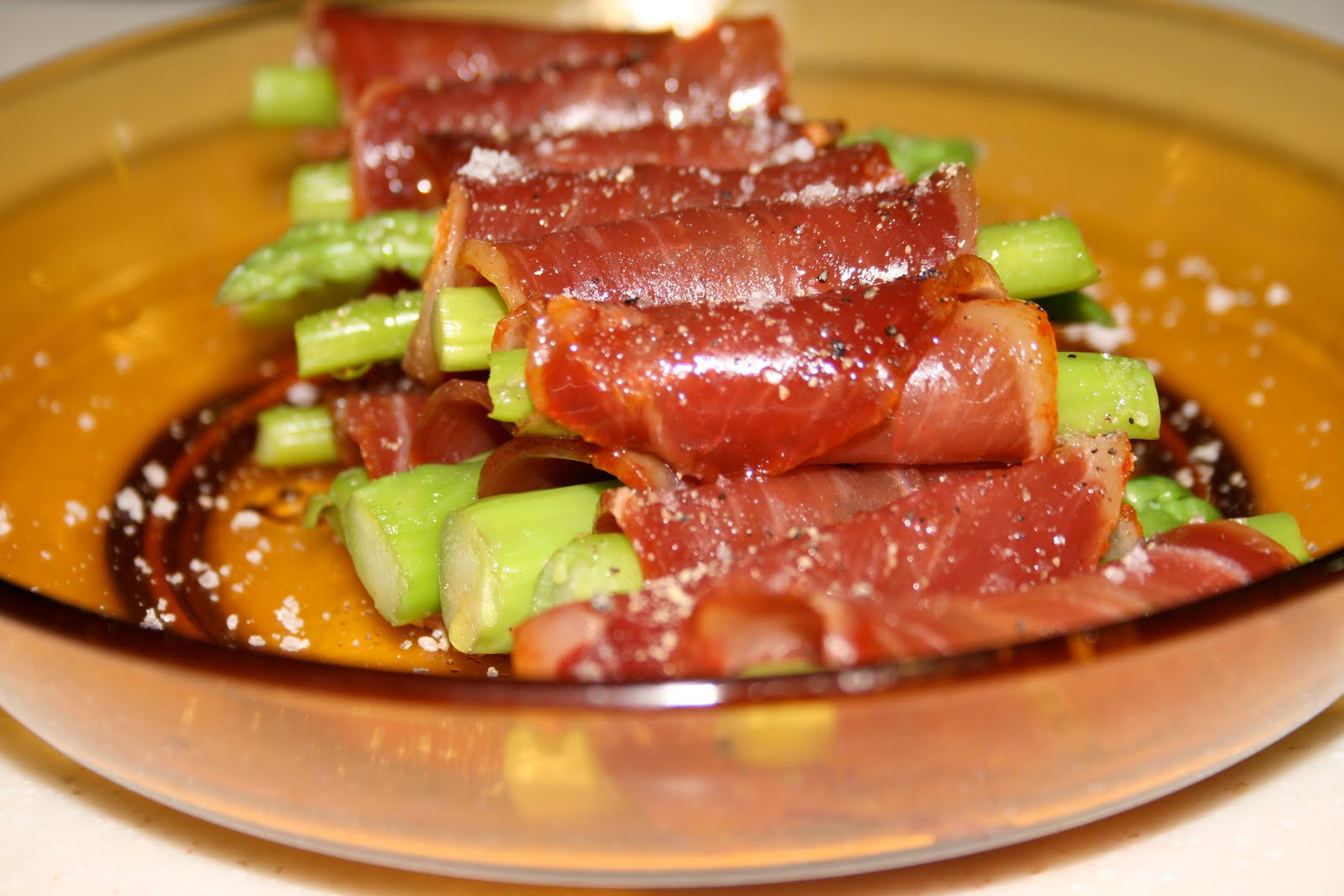
Probably the only thing to come out right of the entire meal, because it required so little work. Asparagus, wrapped in some Spanish jamon that my sister had brought back from her travels, drizzled in olive oil, salted and peppered.

Salad of arugula, roasted red pepper, portabello mushrooms, red onion and leftover asparagus.
Wednesday, May 26, 2010
Goodness in a clay pot
I must admit that for someone as crazy about food as myself, I am rather indifferent when it comes to considering what I actually put in my body. I have friends who are continually curious about the origins of their food and what was done to it, and scrutinise every nutrition label thoroughly keeping a sharp lookout for artificial preservatives or other undesirable ingredients. I know people who treat their bodies as temples, and try not to pollute it with artificial colourings, sweeteners, or other flavour enhancers. I know people who insist on organic – even though that label has come to carry less and less meaning these days. In any case, I must say this mentality is highly commendable. Unfortunately I have always been of the “eat first, think later” persuasion, and to me pleasure has always trumped principle – if something is delicious, I’ll eat it regardless of what nasty ingredients are in it or what unspeakable processes took place before it got to my table.
One of the chief reasons I think the way I do is my weakness for Singaporean hawker food. From a purist’s point of view, hawker food is sin visited upon sin. It is unhealthy – meals are unbalanced, and food is typically oily, fatty, and high in calories. It is not organic – there is widespread use of MSG and other artificial flavour enhancers. Very little thought, if any, is given to processing methods when selecting ingredients – cost is the primary criteria. This means that if you are concerned about your chickens being free-range rather than battery-raised, your flour being unbleached rather than bleached, your sugar being natural rather than refined, then you probably should steer clear of hawker food. But, and to me this is a huge but, the good shit just tastes so fucking good.
This was weighing on my mind the other day as I returned to one of my perennial faves – Yew Chuan claypot rice at the Golden Mile hawker centre on Beach Road. To explain – claypot cooking refers to the cooking of food in clay pots (duh) over high heat. The pots are usually doused in water prior to use so that they release steam during the cooking process and create a steam wall around the food that locks in its moisture, ensuring a tender, flavourful dish. It’s basically one-pot cooking, with a clay pot. These clay pots also absorb flavour, so if you go to those hawkers who have been using the same pots for decades, the food is likely to be very tasty.
Claypot rice refers to a one-dish meal where rice is steamed in the clay pot, with the subsequent addition of ingredients like salted fish, chicken slices, sausage, and a few leafy greens to satisfy the Health Promotion Board. When served it is then typically topped with a generous serving of sweet soy sauce and drizzled with sesame oil, then tossed to coat the rice with the condiments.
For some reason I don’t remember eating claypot rice before my teenage years – I must have, but I just don’t remember it. What I do remember is eating at the Food Junction at Junction 8 after school, where my two go-tos were the claypot rice and the beef noodles. This was before food courts became even more corporatised and sanitised than they already were back then, so the food was actually decent. The best part about the claypot rice was the burnt bits of rice at the bottom, which I dutifully scraped off at the end of the meal and ate. Carcinogens be damned!
The version at Yew Chuan was introduced to me by my mother, bless her heart, and quickly became one of my favourites. Different people have different methods of introducing food to others – my dad always started with the basic premise that quality was not subjective, so if you didn’t appreciate anything he recommended then there was nothing wrong with the food, but instead it had everything to do with your standards. As a result he treated everything he shared with his children as an education of sorts. There was nothing high-handed or snobbish about it – far from it, in fact – but food for him was an induction into the possibilities of pleasure, so that was how he couched every recommendation. Everything was an announcement, something to be pointed out in a matter-of-fact way. You should eat this – it is good. End of discussion. My mother had a different tack, and always took on a conspiratorial tone when recommending something, as if each of her recommendations were some precious secret to be passed on only to those who can be trusted to use the information for good. Psst – I found this stall selling X, see if you like it. As for me, I try as much as possible to curb myself, but when I find something that I like I tend to beat people about the head to get them to try it. Some call it being a food Nazi, I prefer to think of it as exuberance. Maybe, just maybe, this exuberance sometimes takes on an almost indignant tone. Why for the love of all that is holy have you not tried this yet? You need to go there. And try it. Now.
The claypot rice at Yew Chuan has tremendous flavour, for several reasons. One, they add a healthy portion of salted fish, an unbelievable source of umami. Two, the pots look like they have been in use for ages, and I am sure that contributes to the flavour. Three, they give you the soy sauce (home-brewed, I assume) and sesame oil so you can add however much of it as you want. In addition to all this, the rice is always perfectly cooked (save for the layer of burnt rice at the bottom), the chicken chunks always succulent and tender (they use thigh meat, which is juicier).
This time, as I ate the claypot rice I thought a little harder about the various processes and ingredients that went into the pot of food before me. So many ingredients – each with their own little story, and each story with their own twists and turns. Take the soy sauce, for example. Was it brewed naturally by fermenting soybeans, or was it made chemically from hydrolyzed soy protein? What levels of sodium did it have? If it was sweetened, how was this accomplished – through the addition of refined sugar, cane sugar, or molasses? The soy sauce at Yew Chuan comes in a nondescript squeezy bottle, which completely belies the number of choices made prior to it appearing – as if magically – on your table together with your claypot rice.
But once the smell of the claypot rice hit my nostrils, with that insistent aroma of salted fish, the steam escaping as the lid was removed – all was forgotten. In that instant I could only think of how quickly I could stuff as much of that claypot rice into my mouth as possible. As I was wolfing it down (much too quickly, I might add) I felt my body temperature rise due to the ingesting of the still-hot rice, and beads of sweat starting to form around my temples. And yet I still kept reaching for more, more of this sweet, salty, savoury goodness in a pot – consumed solely by the desire to eat, blissfully oblivious to everything else. Conversation slowed. I gave monosyllabic answers to any questions I was asked, and ceded conversation-making duties to someone else at the table, I didn’t care who.
This is not to say that the claypot rice at Yew Chuan is artificial in any way. I honestly do not know. All I know is that I am a fool for it.
In short, I am a lost cause. In my line of work I am exposed to many processed foods, and am much more aware of the choices made in their production than ever before. I know what manufacturers do to enhance flavour, improve colour, impart aroma – naturally or artificially. I know that almost everything is a choice, and when you buy a finished product you often cede thousands of choices up to the many individuals who have worked to get you that finished product. Many of these choices are not made with your long-term well being in mind. I know all that. But when shit is that good, frankly, my dear, I don’t give a damn.
One of the chief reasons I think the way I do is my weakness for Singaporean hawker food. From a purist’s point of view, hawker food is sin visited upon sin. It is unhealthy – meals are unbalanced, and food is typically oily, fatty, and high in calories. It is not organic – there is widespread use of MSG and other artificial flavour enhancers. Very little thought, if any, is given to processing methods when selecting ingredients – cost is the primary criteria. This means that if you are concerned about your chickens being free-range rather than battery-raised, your flour being unbleached rather than bleached, your sugar being natural rather than refined, then you probably should steer clear of hawker food. But, and to me this is a huge but, the good shit just tastes so fucking good.
This was weighing on my mind the other day as I returned to one of my perennial faves – Yew Chuan claypot rice at the Golden Mile hawker centre on Beach Road. To explain – claypot cooking refers to the cooking of food in clay pots (duh) over high heat. The pots are usually doused in water prior to use so that they release steam during the cooking process and create a steam wall around the food that locks in its moisture, ensuring a tender, flavourful dish. It’s basically one-pot cooking, with a clay pot. These clay pots also absorb flavour, so if you go to those hawkers who have been using the same pots for decades, the food is likely to be very tasty.
Claypot rice refers to a one-dish meal where rice is steamed in the clay pot, with the subsequent addition of ingredients like salted fish, chicken slices, sausage, and a few leafy greens to satisfy the Health Promotion Board. When served it is then typically topped with a generous serving of sweet soy sauce and drizzled with sesame oil, then tossed to coat the rice with the condiments.
For some reason I don’t remember eating claypot rice before my teenage years – I must have, but I just don’t remember it. What I do remember is eating at the Food Junction at Junction 8 after school, where my two go-tos were the claypot rice and the beef noodles. This was before food courts became even more corporatised and sanitised than they already were back then, so the food was actually decent. The best part about the claypot rice was the burnt bits of rice at the bottom, which I dutifully scraped off at the end of the meal and ate. Carcinogens be damned!
The version at Yew Chuan was introduced to me by my mother, bless her heart, and quickly became one of my favourites. Different people have different methods of introducing food to others – my dad always started with the basic premise that quality was not subjective, so if you didn’t appreciate anything he recommended then there was nothing wrong with the food, but instead it had everything to do with your standards. As a result he treated everything he shared with his children as an education of sorts. There was nothing high-handed or snobbish about it – far from it, in fact – but food for him was an induction into the possibilities of pleasure, so that was how he couched every recommendation. Everything was an announcement, something to be pointed out in a matter-of-fact way. You should eat this – it is good. End of discussion. My mother had a different tack, and always took on a conspiratorial tone when recommending something, as if each of her recommendations were some precious secret to be passed on only to those who can be trusted to use the information for good. Psst – I found this stall selling X, see if you like it. As for me, I try as much as possible to curb myself, but when I find something that I like I tend to beat people about the head to get them to try it. Some call it being a food Nazi, I prefer to think of it as exuberance. Maybe, just maybe, this exuberance sometimes takes on an almost indignant tone. Why for the love of all that is holy have you not tried this yet? You need to go there. And try it. Now.
The claypot rice at Yew Chuan has tremendous flavour, for several reasons. One, they add a healthy portion of salted fish, an unbelievable source of umami. Two, the pots look like they have been in use for ages, and I am sure that contributes to the flavour. Three, they give you the soy sauce (home-brewed, I assume) and sesame oil so you can add however much of it as you want. In addition to all this, the rice is always perfectly cooked (save for the layer of burnt rice at the bottom), the chicken chunks always succulent and tender (they use thigh meat, which is juicier).
This time, as I ate the claypot rice I thought a little harder about the various processes and ingredients that went into the pot of food before me. So many ingredients – each with their own little story, and each story with their own twists and turns. Take the soy sauce, for example. Was it brewed naturally by fermenting soybeans, or was it made chemically from hydrolyzed soy protein? What levels of sodium did it have? If it was sweetened, how was this accomplished – through the addition of refined sugar, cane sugar, or molasses? The soy sauce at Yew Chuan comes in a nondescript squeezy bottle, which completely belies the number of choices made prior to it appearing – as if magically – on your table together with your claypot rice.
But once the smell of the claypot rice hit my nostrils, with that insistent aroma of salted fish, the steam escaping as the lid was removed – all was forgotten. In that instant I could only think of how quickly I could stuff as much of that claypot rice into my mouth as possible. As I was wolfing it down (much too quickly, I might add) I felt my body temperature rise due to the ingesting of the still-hot rice, and beads of sweat starting to form around my temples. And yet I still kept reaching for more, more of this sweet, salty, savoury goodness in a pot – consumed solely by the desire to eat, blissfully oblivious to everything else. Conversation slowed. I gave monosyllabic answers to any questions I was asked, and ceded conversation-making duties to someone else at the table, I didn’t care who.
This is not to say that the claypot rice at Yew Chuan is artificial in any way. I honestly do not know. All I know is that I am a fool for it.
In short, I am a lost cause. In my line of work I am exposed to many processed foods, and am much more aware of the choices made in their production than ever before. I know what manufacturers do to enhance flavour, improve colour, impart aroma – naturally or artificially. I know that almost everything is a choice, and when you buy a finished product you often cede thousands of choices up to the many individuals who have worked to get you that finished product. Many of these choices are not made with your long-term well being in mind. I know all that. But when shit is that good, frankly, my dear, I don’t give a damn.
Subscribe to:
Posts (Atom)


 Posts
Posts


