Thanksgiving came and went in Singapore last week without so much as a whimper, and if not for the blow-by-blow reports of extreme eating from the usual suspects back in the States, I would have been none the wiser. It is not a holiday we celebrate here, but it is a tradition I have come to appreciate having experienced it several times over the last couple of years. The practice of giving thanks, in particular, is one we all could use a little more of. I know it is not every family that is deliberate about this, but I do think that at the pace we live in these days - it is sometimes difficult remembering to express our gratitude for the small mercies that get us through the day.
Besides, it is not every day that we are permitted, even encouraged, to eat and drink to excess. I spent Thanksgiving at the Salgado household twice and both times the amount of food laid out before us was staggering. Both years we struggled manfully to even make a dent in the spread, and each time we swore never to touch turkey again. Of course, we ate nothing but turkey the next couple of days, and obviously we did it all over again the next year.
I’m not sure if I am expressing a controversial opinion here but I do believe that my favourite traditional Thanksgiving food is the stuffing. I can’t get enough of it, especially the stuffing that has been cooked in the turkey. If done right it is moist and flavoured with the juices of the turkey, yet the faint crunch of the pre-toasted bread is still present, and the aroma of the herbs fills the air. Eating turkey with stuffing elevates it to a different level, because the flavours used in stuffing – typically intense, usually herb-based – are a perfect foil for the lightness of the turkey meat.
The one year that I made stuffing for Thanksgiving, I asked Morgan’s mother to send me her recipe – for Morgan had made it for us once before and I remembered it to be delightful. She duly obliged, with the caveat that she “sounded like a mother” in the recipes. I was later very thankful for this fact, because what sounded like a mother’s words to her was in fact invaluable practical advice that is so often missing in traditional recipes.
There is an art to writing a good recipe that I believe is often overlooked. I don’t use a lot of recipes, but when I do – I don’t particularly care for the amounts and the quantities of the ingredients, or sometimes even the ingredients themselves. I add however much I want to taste, or switch out the ingredients if I want to work with something else. I don’t particularly care for the steps laid out in the recipe either, because most of it is common sense. What I am looking out for in a recipe is information on how the ingredients are going to react to being manipulated, and what to do about it. I want to know what is going to happen when I subject something to heat, with any number of heating methods; or what is going to happen when I leave something out in the open for a period of time. I want to know what to look out for to tell when something is done. In essence, when I look at a recipe I want to understand not how to create the final product, but rather how to work with the ingredients involved to get the best out of them.
I can think of a particular example. When I first started cooking I attempted to work with eggplant one night – and must have read several different recipes I found online, hoping to extract the best out of all of them. I thought I had made a decent fist of the recipes, but the eventual dish was bitter beyond belief, and had an unforgiving texture. I later found out that you were supposed to salt eggplant heavily before even working with them – drawing out their moisture and degorging them of the bitter liquid that is found within their seeds. It made me positively mad that none of the recipes I read had even mentioned this. To me, this is exactly the kind of information that you should include in a recipe.
And so it was that I was thankful for clear, concise and common-sense instructions within Morgan’s family recipe for stuffing. Understanding the recipe not as a series of steps or chronological events, but rather as a field guide to ingredients and the nature of the activities required to transform them – gives any reader a whole hell of a lot more useful information. It gave me the license and confidence to adapt the recipe and fashion it in a direction more aligned with what I wanted to make and eat.
So here it is, my adapted version of Thanksgiving stuffing. Apart from some minor tweaks to the ingredients I have also added a couple more. I put shitake mushrooms in the stuffing because firstly I like the taste, and secondly mushrooms release a lot of water when cooked, and this helps to keep the stuffing from drying out. Also, I include dried cranberries because I think they add an additional texture, and the dried fruit complements the veal very well if you are eating the stuffing by itself as a casserole.
Thanksgiving Veal Stuffing with Cranberries (inspired by Janet Lindgren)
About 10 cups of crusty, country-style white bread, cut into 1/3-inch cubes. [This will make more than you can put in the turkey. Make less or bake the rest in a casserole]
1 Tablespoon butter
1 Tablespoon olive oil
¾ cup finely diced onions
¾ cup finely diced leeks
¾ cup finely diced carrots
¾ cup finely diced celery
1 cup diced shitake mushrooms
3 Tablespoons chopped fresh sage
2 tablespoons chopped fresh rosemary
2 tablespoons fresh thyme leaves
½ cup dry white wine (or stock)
1 pound ground veal
2 slices country bacon, chopped coarsely into bits
½ cup (packed) chopped fresh parsley
1 cup dried cranberries
3 large eggs
1 teaspoon salt
1 teaspoon ground nutmeg
1 teaspoon ground black pepper
1 cup (about) canned chicken broth
Preheat oven to 350 degrees. Spread bread on 2 large rimmed baking sheets. Bake until golden brown, stirring occasionally, about 30 minutes.
In a roasting pan, combine onions, leeks, carrots and celery and drizzle with olive oil. Bake in the oven with the bread cubes for about 20 minutes, stirring occasionally – until top layer has a golden tinge but is not yet browned.
Melt butter with oil in heavy large skillet over medium-high heat. Brown veal and cook through, breaking up with the back of a fork. Remove and set aside. Add bacon and fry until fat is rendered. Add onions, leeks, carrots and celery and sauté about 2 minutes. Add mushrooms and sauté for further 4 minutes. Add sage; sauté 1 minute. Add wine. Boil until wine evaporates, about 1 minute. Add veal back in and cook further for about 2-3 minutes. Cool slightly.
(Bread and veal mixture can be prepared 1 day ahead. Cover separately. Store bread at room temperature; refrigerate veal mixture.)
(Some recipes for stuffing call for the bread cubes to be further broken up into crumbs with the use of a food processor. Personally, I like the cubes better.)
Stir veal mixture, parsley and cranberries into bread cubes. Whisk eggs, salt, nutmeg and pepper in medium bowl. Mix into stuffing. If seems too dry add more broth. Will get moister in the bird. Will get drier in a casserole.
(When stuffing the turkey, do not pack it in tightly. Leave about 1/4 of the cavity unfilled; the stuffing will expand as the bird roasts.)
Showing posts with label recipe. Show all posts
Showing posts with label recipe. Show all posts
Thursday, December 04, 2008


Wednesday, September 17, 2008
"When the cod went so cheap, but so plenty"
A couple of weeks ago I actually cooked at home... a rarity, by any measure. I have been working in the restaurant business for a while now and being away from your home five nights a week makes it hard to even keep any food in house, much less make anything good. I always find that I making relatively simple dishes, ones that don't require super long prep times; I'm not braising beef or pork on my day off. I tend to favor fish or cuts of meat that need a relatively short cooking time, pork chops, sirloin, chicken, etc.
In this case I made a shrimp pasta to start, very simple. Seared the shrimp in hot olive oil, set aside. Sweat onion and garlic in the same pan, also olive oil. White wine, bring to simmer, add canned tomato, cook out for 15-20 mins. Season with kosher salt and red pepper flakes. Add the linguine to the sauce and finish cooking. Dilute sauce with pasta water if necessary. Re-add shrimp with some parsley chiffonade.
For a second course I made cod. I love cod, but more than cod I love bacalhau, salt preserved cod. The drying process of making bacalhau insures that what mild flavor the fish has is concentrated and the quantity of salt insures that one's taste buds jump to attention. Unfortunately I had to settle for fresh cod in this case. I prepared it with a fennel, onion, chorizo and parsley salad. I sauced it with no more than lemon juice and olive oil. First I sliced the chorizo into rounds and rendered them over medium heat in olive oil. I set them aside and placed them in a bowl with sliced fennel, red onion half-moons, and parlsey, seasoned with salt. Meanwhile I dusted the cod with salt and flour and fried it in the chorizo oil, at first over high heat to get it some color then over medium low to let it cook through. I dressed the salad with good olive oil and lemon juice. If I had been making this a more haute preparation I think that a preserved lemon vinaigrette would have been great. Otherwise, a mayonnaise based sauce could be really great. Not to mention using bacalhau. Also, a high quality chorizo is necessary. I used a Goya chorizo and it just wasn't doing it for me. Here's a mediocre picture:
 On the whole, I thought it was a very good meal, and we were drinking a very nice rose cava, which went quite well with both dishes. It was creamy, yeasty, with a mild red fruit profile, very refreshing, plenty of acidity. It might be enough to get me to cook a home a little more.
In this case I made a shrimp pasta to start, very simple. Seared the shrimp in hot olive oil, set aside. Sweat onion and garlic in the same pan, also olive oil. White wine, bring to simmer, add canned tomato, cook out for 15-20 mins. Season with kosher salt and red pepper flakes. Add the linguine to the sauce and finish cooking. Dilute sauce with pasta water if necessary. Re-add shrimp with some parsley chiffonade.
For a second course I made cod. I love cod, but more than cod I love bacalhau, salt preserved cod. The drying process of making bacalhau insures that what mild flavor the fish has is concentrated and the quantity of salt insures that one's taste buds jump to attention. Unfortunately I had to settle for fresh cod in this case. I prepared it with a fennel, onion, chorizo and parsley salad. I sauced it with no more than lemon juice and olive oil. First I sliced the chorizo into rounds and rendered them over medium heat in olive oil. I set them aside and placed them in a bowl with sliced fennel, red onion half-moons, and parlsey, seasoned with salt. Meanwhile I dusted the cod with salt and flour and fried it in the chorizo oil, at first over high heat to get it some color then over medium low to let it cook through. I dressed the salad with good olive oil and lemon juice. If I had been making this a more haute preparation I think that a preserved lemon vinaigrette would have been great. Otherwise, a mayonnaise based sauce could be really great. Not to mention using bacalhau. Also, a high quality chorizo is necessary. I used a Goya chorizo and it just wasn't doing it for me. Here's a mediocre picture:
 On the whole, I thought it was a very good meal, and we were drinking a very nice rose cava, which went quite well with both dishes. It was creamy, yeasty, with a mild red fruit profile, very refreshing, plenty of acidity. It might be enough to get me to cook a home a little more.
Thursday, June 05, 2008
By request
Michael asked for the short ribs recipe from a previous post, so here it is:
Barolo Braised Beef Short Ribs
3 lbs. bone-in beef short ribs
1 carrot, coarsely chopped
1 onion, coarsely chopped
2 stalks celery, coarsely chopped
1 leek, coarsely chopped
4 cloves garlic, coarsely chopped
4 vine tomatoes
1 bottle Barolo or any other full-bodied red wine
1 cup chicken stock
2 strips pancetta or bacon
Paprika
Worcestershire sauce
Balsamic vinegar
Honey
Brown sugar (optional)
2 bay leaves
2 sprigs rosemary
Pre-heat the oven to 400F.
Mix olive oil, salt, pepper, 1 tsp Worcestershire sauce, 2 tsp balsamic vinegar, 1 tsp paprika, and coat the short ribs with the mixture. Set aside for 15-20 minutes.
Put the chopped vegetables in a roasting pan, drizzle with olive oil, salt and pepper and then roast in the oven for 20 minutes, turning regularly to avoid crisping of the top layer. Roasting helps bring out the flavour of the vegetables and creates a stronger base when you use them later in the stew.
Meanwhile, in a large pot, fry the pancetta or bacon till crispy, then remove. Brown the ribs in batches, removing when done.
Transfer the vegetables to the pot and sauté further till caramelized, about 3-4 minutes. Add a tablespoon of brown sugar to aid the process. You should be able to smell a sweetness to the vegetables if you poke your nose into the pan.
Add 2 cups wine and chicken stock, scraping up any brown bits at the bottom of the pan, and then bring mixture to a simmer. Add the bay leaves, rosemary, then the short ribs and the pancetta or bacon. If the short ribs are not entirely covered, add more wine to do so.
At this point you can slow cook the short ribs one of three ways. You can bring it to a simmer and keep it on the stovetop for 4-5 hours. You can cover the pot with tin foil and transfer to the oven, and cook at 350F for 4-5 hours. Or, you can transfer the stew to a crockpot and cook it on low for 8 hours. I have achieved the best results with the crockpot, but time may restrict your choices.
When the short ribs are done, remove from the stew and set aside for plating. Take the remaining mixture and pour it through a colander into a fat separator. Once you have isolated the braising liquid, put it into a saucepan and bring to a simmer on the stovetop. Add honey and reduce until the liquid is a nappé consistency. This means that you should be able to coat the back of a spoon with it.
To plate, serve short ribs with a heavy starch (rice or potatoes work best), drizzle with sauce and voila!

Barolo Braised Beef Short Ribs
3 lbs. bone-in beef short ribs
1 carrot, coarsely chopped
1 onion, coarsely chopped
2 stalks celery, coarsely chopped
1 leek, coarsely chopped
4 cloves garlic, coarsely chopped
4 vine tomatoes
1 bottle Barolo or any other full-bodied red wine
1 cup chicken stock
2 strips pancetta or bacon
Paprika
Worcestershire sauce
Balsamic vinegar
Honey
Brown sugar (optional)
2 bay leaves
2 sprigs rosemary
Pre-heat the oven to 400F.
Mix olive oil, salt, pepper, 1 tsp Worcestershire sauce, 2 tsp balsamic vinegar, 1 tsp paprika, and coat the short ribs with the mixture. Set aside for 15-20 minutes.
Put the chopped vegetables in a roasting pan, drizzle with olive oil, salt and pepper and then roast in the oven for 20 minutes, turning regularly to avoid crisping of the top layer. Roasting helps bring out the flavour of the vegetables and creates a stronger base when you use them later in the stew.
Meanwhile, in a large pot, fry the pancetta or bacon till crispy, then remove. Brown the ribs in batches, removing when done.
Transfer the vegetables to the pot and sauté further till caramelized, about 3-4 minutes. Add a tablespoon of brown sugar to aid the process. You should be able to smell a sweetness to the vegetables if you poke your nose into the pan.
Add 2 cups wine and chicken stock, scraping up any brown bits at the bottom of the pan, and then bring mixture to a simmer. Add the bay leaves, rosemary, then the short ribs and the pancetta or bacon. If the short ribs are not entirely covered, add more wine to do so.
At this point you can slow cook the short ribs one of three ways. You can bring it to a simmer and keep it on the stovetop for 4-5 hours. You can cover the pot with tin foil and transfer to the oven, and cook at 350F for 4-5 hours. Or, you can transfer the stew to a crockpot and cook it on low for 8 hours. I have achieved the best results with the crockpot, but time may restrict your choices.
When the short ribs are done, remove from the stew and set aside for plating. Take the remaining mixture and pour it through a colander into a fat separator. Once you have isolated the braising liquid, put it into a saucepan and bring to a simmer on the stovetop. Add honey and reduce until the liquid is a nappé consistency. This means that you should be able to coat the back of a spoon with it.
To plate, serve short ribs with a heavy starch (rice or potatoes work best), drizzle with sauce and voila!

Wednesday, November 21, 2007
Life, liberty, and the pursuit of the perfect chili recipe
I know it is somewhat irrational, but I always get mildly annoyed whenever asked the question, “So what kind of food do you cook?” I think this is due to the fact that I cannot answer the question, at least not succinctly. I think of cooking first and foremost in terms of techniques, then in terms of ingredients, and then cuisines. This is to say that in my mind my cooking knowledge is primarily organised in terms of “how-to”s – how to salt-crust a sea bass, how to confit a duck leg – and secondarily in terms of “what”s – I love working with red meats and shellfish, and have a weakness for garlic. It is not often instinctive, for me, to identify a dish I make with its country or culture of origin.
Yet it is almost always the case that its place of origin is central to the dish itself, and cannot be ignored. Take Texas-style chili, for example. For me at least, it conjures images of a chilly December evening somewhere in the Lone Star State – with gray skies and fast fading light at five o’clock in the afternoon and a pot of chili simmering on the stove. Now I have never lived in Texas, but it is almost as if I did not need to. Here is my adaptation of Texas-style chili – traditionally made with beef but in this case with the addition of gamier meats – using cooking techniques I have picked up along the years that may not necessarily be traditional to making chili. Simon, Joanna and I made this recipe for this year's edition of Frank's Chili Bowl, our annual DC chili cookoff. It was, I'd like to think, very well received, but we still came in second to a team who not only bribed the judges with a round of shots, but who had also added corn to their chili. The humanity!
Yes, I am bitter. Deal with it.
Three-Meat, Three-Bean, "Team Gravedigga-digga-digga" Chili
2 pounds venison, ground
2 pounds wild boar, ground
1 pound beef (at least 90% lean), ground
2 bay leaves
Peppercorns
1 can Guinness
1 can black beans
1 can red kidney beans
1 can pinto beans
1 head garlic
2 leeks, diced
1 large onion, diced
2 sticks celery, diced
3 bell peppers, roasted and diced
4 habanero peppers, diced
4 jalapeno peppers, diced
4 poblano peppers, diced
3 tomatoes
1 can tomato paste
1½ cups beef broth
Paprika
Cayenne
Cumin
Chili Powder
Nutmeg
Oregano
Old Bay seasoning
Hot Sauce
2 strips bacon
½ stick butter
2 tbsp all-purpose flour
Honey
1 tsp espresso beans, ground
1 square unsweetened baking chocolate
Mix the ground meats and rub thoroughly with the dry spices, salt and pepper, moistening slightly with hot sauce if needed. Leave the meats to sit for 45 minutes to half an hour. Add the Guinness, making sure to submerge the meats. Add two bay leaves and a handful of loose peppercorns to the mixture and refrigerate at least 3 hours and preferably overnight. The beer marinade helps to soften the gaminess of the venison, and is an important step not to be rushed.
Pre-heat oven to 400F.
Cut the top of the head of garlic and roast in tin foil with a drizzle of olive oil for 15 to 20 minutes, till browned. Remove and set aside till cool enough to be handled. Meanwhile, place the leeks, onions, celery and tomatoes in a baking pan, drizzle with olive oil and season lightly with all of the dry spices. Roast at 400F for 25 to 30 minutes. Roasting vegetables before adding them to the chili helps to bring out and intensify their flavours.
While the vegetables are roasting, render the fat from the bacon in a large pot and then brown the meat in batches, removing when done. Reserve any drippings. In the same pot, melt the butter on high heat – you should smell a nutty aroma from the burning butter – taking care not to let it get too hot. Once butter is entirely melted, remove from heat and stir in flour. Mix well into a thick, gooey brown paste. This is called making a roux. Keep mixing and bring the roux back onto low heat. Ideally you want to cook your roux to a honey nut brown colour, which usually takes 10 to 12 minutes.
Once you have made your roux, add the vegetables and diced peppers and cook well, about 6 to 8 minutes. Smash and mince the roasted garlic and add to the pot. Season with the dry spices. It is important to allow the vegetables to cook for a little while before seasoning or adding the other ingredients, to create a good soffritto, or flavour base.
Add the meats, drippings, beef broth, honey, tomato paste, espresso grounds and baking chocolate; and season to taste with the dry spices and hot sauce. Bring to a gentle boil and then allow the chili to cook at a simmer for at least 3 hours. About 1 and a half hours before your scheduled end, add the beans to the mixture. This will ensure that the beans cook through, but are still somewhat firm to the bite.
Makes roughly 5 quarts of chili – which probably serves about 10-15 people.
Variation: Different meats can be used if venison or wild boar are not readily available. However, one should take care to use different meats, or if restricted to one particular meat, at least different cuts of the same meat (eg. chuck, top loin, and oxtail of beef). This gives the chili depth of flavour.
Note: I have left out quantities of the dry spices because I do not know exactly how much we used, and because I also believe, anyway, that this is a matter of tasting for personal preference and should be left up to the individual chef to decide.
Yet it is almost always the case that its place of origin is central to the dish itself, and cannot be ignored. Take Texas-style chili, for example. For me at least, it conjures images of a chilly December evening somewhere in the Lone Star State – with gray skies and fast fading light at five o’clock in the afternoon and a pot of chili simmering on the stove. Now I have never lived in Texas, but it is almost as if I did not need to. Here is my adaptation of Texas-style chili – traditionally made with beef but in this case with the addition of gamier meats – using cooking techniques I have picked up along the years that may not necessarily be traditional to making chili. Simon, Joanna and I made this recipe for this year's edition of Frank's Chili Bowl, our annual DC chili cookoff. It was, I'd like to think, very well received, but we still came in second to a team who not only bribed the judges with a round of shots, but who had also added corn to their chili. The humanity!
Yes, I am bitter. Deal with it.
Three-Meat, Three-Bean, "Team Gravedigga-digga-digga" Chili
2 pounds venison, ground
2 pounds wild boar, ground
1 pound beef (at least 90% lean), ground
2 bay leaves
Peppercorns
1 can Guinness
1 can black beans
1 can red kidney beans
1 can pinto beans
1 head garlic
2 leeks, diced
1 large onion, diced
2 sticks celery, diced
3 bell peppers, roasted and diced
4 habanero peppers, diced
4 jalapeno peppers, diced
4 poblano peppers, diced
3 tomatoes
1 can tomato paste
1½ cups beef broth
Paprika
Cayenne
Cumin
Chili Powder
Nutmeg
Oregano
Old Bay seasoning
Hot Sauce
2 strips bacon
½ stick butter
2 tbsp all-purpose flour
Honey
1 tsp espresso beans, ground
1 square unsweetened baking chocolate
Mix the ground meats and rub thoroughly with the dry spices, salt and pepper, moistening slightly with hot sauce if needed. Leave the meats to sit for 45 minutes to half an hour. Add the Guinness, making sure to submerge the meats. Add two bay leaves and a handful of loose peppercorns to the mixture and refrigerate at least 3 hours and preferably overnight. The beer marinade helps to soften the gaminess of the venison, and is an important step not to be rushed.
Pre-heat oven to 400F.
Cut the top of the head of garlic and roast in tin foil with a drizzle of olive oil for 15 to 20 minutes, till browned. Remove and set aside till cool enough to be handled. Meanwhile, place the leeks, onions, celery and tomatoes in a baking pan, drizzle with olive oil and season lightly with all of the dry spices. Roast at 400F for 25 to 30 minutes. Roasting vegetables before adding them to the chili helps to bring out and intensify their flavours.
While the vegetables are roasting, render the fat from the bacon in a large pot and then brown the meat in batches, removing when done. Reserve any drippings. In the same pot, melt the butter on high heat – you should smell a nutty aroma from the burning butter – taking care not to let it get too hot. Once butter is entirely melted, remove from heat and stir in flour. Mix well into a thick, gooey brown paste. This is called making a roux. Keep mixing and bring the roux back onto low heat. Ideally you want to cook your roux to a honey nut brown colour, which usually takes 10 to 12 minutes.
Once you have made your roux, add the vegetables and diced peppers and cook well, about 6 to 8 minutes. Smash and mince the roasted garlic and add to the pot. Season with the dry spices. It is important to allow the vegetables to cook for a little while before seasoning or adding the other ingredients, to create a good soffritto, or flavour base.
Add the meats, drippings, beef broth, honey, tomato paste, espresso grounds and baking chocolate; and season to taste with the dry spices and hot sauce. Bring to a gentle boil and then allow the chili to cook at a simmer for at least 3 hours. About 1 and a half hours before your scheduled end, add the beans to the mixture. This will ensure that the beans cook through, but are still somewhat firm to the bite.
Makes roughly 5 quarts of chili – which probably serves about 10-15 people.
Variation: Different meats can be used if venison or wild boar are not readily available. However, one should take care to use different meats, or if restricted to one particular meat, at least different cuts of the same meat (eg. chuck, top loin, and oxtail of beef). This gives the chili depth of flavour.
Note: I have left out quantities of the dry spices because I do not know exactly how much we used, and because I also believe, anyway, that this is a matter of tasting for personal preference and should be left up to the individual chef to decide.
Monday, August 27, 2007
A tribute to the Stone Home Wine Bar
As I have written in these pages before – I am a fool for offal. Liver, especially, is one of my favourites. I can remember the look that my father gave me when, as a five year-old, I must have surprised him by displaying a hearty appetite for the pan-fried pork livers that he loved so dearly. My father was a very private man but even he could not disguise the happiness that showed so clearly on his face. In later years he mastered the art of acting all put out – at having to deal with competition at the dinner table for this otherwise unpopular delicacy – but I knew he was secretly pleased that he had been able to share his love for liver with at least one of his children.
What he did not do, though, was share his alleged love for cooking with any of his children at all. Growing up we heard stories – from our mother, our aunts and all manner of others who had had the fortune of tasting my father’s cooking – about how wonderful a chef our father was. There was the story of how, as a ten-year-old, my father averted a near disaster and saved a dinner party for twelve when his mother, my grandmother, was stranded while out running errands. It must have been embellished and retold many times over the years because by the time we heard the story it sounded like my father had, at the last minute, thrown together a multi-course meal with nothing more than a pair of scissors, some tongs, and a paper clip.
But he rarely, if ever, cooked for us – that was left to my mother or our housemaid who ran the kitchen with her own idiosyncratic efficiency. I personally never knew where anything ever was, yet she would be able to produce it out of a hidden cupboard within seconds. It was quite marvelous, really, what else she could whip up at a moment’s notice. She would make me full meals out of nothing at all when I would come home late from rugby practice, and I never thought to question how it was she seemed to have everything prepped at any given time, for whatever I was in the mood for. Years later as I started to cook myself, I wondered how she did it; and I realised just what a feat of organisation running a kitchen actually was.
Yet I digress. The other day I felt in the mood for some liver, so I decided to make a chicken liver mousse – something I had never done before. I had had one that Morgan made at the wine bar he worked at, so I knew that he knew how to do it; and he graciously told me how over the phone as I walked the aisles at Whole Foods. I bought a crusty wheat baguette to go with it, and went on my way.
It is strangely satisfying when you add a new recipe, or a technique, to your repertoire, and it was this satisfied feeling that came over me as I tasted the warm mousse when I was done making it. I had done good.
I was relieved when Mike and Marc both admitted that they liked liver too – for I had not considered the dietary preferences of my guests for the meal at all. The mousse turned out pretty well, if I may say so myself; I had added some port wine to Morgan’s recipe and it worked wonders. It is a crying shame that one can only eat so much liver at a go; especially when there is still a pasta appetiser and a main course of pork to go. I was a happy camper at the end of the meal, and we went off on our way to get ourselves more intoxicated.
Chicken Liver Mousse, or Mousse de foies de volailles
inspired by the Stone Home Wine Bar
1 pound chicken livers, washed and cleaned
1 + ½ stick butter
2 cloves garlic
1 large shallot
½ cup port wine
1 tbsp nutmeg
1 tbsp allspice
Salt and pepper
Marinate the livers in the port wine for 30 minutes. Finely dice the garlic and shallot and sauté them in the ½ stick of butter over medium heat. Add the livers and spices, reserving the port marinade and sauté till browned, about 3 minutes each side. Add the port and reduce until half the liquid is gone.
In a blender or food processor, blend the warm liver mixture and add the remaining butter in small pieces. According to Morgan, the butter that is added here should preferably be cold, because it emulsifies better. Once the livers and the butter combine, remove and place in a mold. You should line the mold with saran wrap so that you can pull the mousse out easily when serving. Refrigerate for at least 2 hours. Serves 6 as an appetiser.
What he did not do, though, was share his alleged love for cooking with any of his children at all. Growing up we heard stories – from our mother, our aunts and all manner of others who had had the fortune of tasting my father’s cooking – about how wonderful a chef our father was. There was the story of how, as a ten-year-old, my father averted a near disaster and saved a dinner party for twelve when his mother, my grandmother, was stranded while out running errands. It must have been embellished and retold many times over the years because by the time we heard the story it sounded like my father had, at the last minute, thrown together a multi-course meal with nothing more than a pair of scissors, some tongs, and a paper clip.
But he rarely, if ever, cooked for us – that was left to my mother or our housemaid who ran the kitchen with her own idiosyncratic efficiency. I personally never knew where anything ever was, yet she would be able to produce it out of a hidden cupboard within seconds. It was quite marvelous, really, what else she could whip up at a moment’s notice. She would make me full meals out of nothing at all when I would come home late from rugby practice, and I never thought to question how it was she seemed to have everything prepped at any given time, for whatever I was in the mood for. Years later as I started to cook myself, I wondered how she did it; and I realised just what a feat of organisation running a kitchen actually was.
Yet I digress. The other day I felt in the mood for some liver, so I decided to make a chicken liver mousse – something I had never done before. I had had one that Morgan made at the wine bar he worked at, so I knew that he knew how to do it; and he graciously told me how over the phone as I walked the aisles at Whole Foods. I bought a crusty wheat baguette to go with it, and went on my way.
It is strangely satisfying when you add a new recipe, or a technique, to your repertoire, and it was this satisfied feeling that came over me as I tasted the warm mousse when I was done making it. I had done good.
I was relieved when Mike and Marc both admitted that they liked liver too – for I had not considered the dietary preferences of my guests for the meal at all. The mousse turned out pretty well, if I may say so myself; I had added some port wine to Morgan’s recipe and it worked wonders. It is a crying shame that one can only eat so much liver at a go; especially when there is still a pasta appetiser and a main course of pork to go. I was a happy camper at the end of the meal, and we went off on our way to get ourselves more intoxicated.
Chicken Liver Mousse, or Mousse de foies de volailles
inspired by the Stone Home Wine Bar
1 pound chicken livers, washed and cleaned
1 + ½ stick butter
2 cloves garlic
1 large shallot
½ cup port wine
1 tbsp nutmeg
1 tbsp allspice
Salt and pepper
Marinate the livers in the port wine for 30 minutes. Finely dice the garlic and shallot and sauté them in the ½ stick of butter over medium heat. Add the livers and spices, reserving the port marinade and sauté till browned, about 3 minutes each side. Add the port and reduce until half the liquid is gone.
In a blender or food processor, blend the warm liver mixture and add the remaining butter in small pieces. According to Morgan, the butter that is added here should preferably be cold, because it emulsifies better. Once the livers and the butter combine, remove and place in a mold. You should line the mold with saran wrap so that you can pull the mousse out easily when serving. Refrigerate for at least 2 hours. Serves 6 as an appetiser.
Monday, December 18, 2006
If it be not now, yet it will come
Amanda was the first to arrive, and as I met her in the doorway we both – from afar, in that manner of two people excited to see one another – unloaded in our attempts to get the first word in. She won handily, of course; with words that were not so much accusatory but rather tinged with relief at the absolution of guilt. “You didn’t answer your phone, and your doorbell’s not working. But I’m on time!”
I forget now what it was I was about to say, but I am sure it did not matter, for she had come to dinner and was, as she pointed out, prompt. There were deviled egg appetisers made especially for her, and a bottle of wine already open, so I went into the kitchen to fetch both. Amanda followed me in and we talked as though already deeply into conversation: of lives and loves and of discovery and worry, of corned beef sandwiches, or in short – the things that mattered. There was a moment where I looked at her as I held out a wine glass and she fumbled to remove her coat: Amanda has stringy chestnut hair and a smile as disarming as it is naughty, and a warm, inexorable earnestness that takes a piece of my heart away every damn time.
Allison was the next to arrive, and let herself in as Amanda and I were busy with our respective tasks in the kitchen: her, drinking and talking and I, cooking and listening. In truth the food was mostly done or prepped before anyone had come over; I had made the deviled eggs earlier that morning, Laura’s lentil burgers in the afternoon and the ravioli just minutes before. The fish was ready to go in the oven, the béchamel was bubbling weakly on the stovetop, and the bread already sliced. I am not by nature a planner or a maker of lists, but in food I know one thing if any: that readiness is all.
The kitchen of the house I grew up in was never very conducive to conversation. It was a square-shaped room, small, and was not lit very well. There were two doors, one coming from the dining room and the other directly across from it, leading out to the back yard. Something about how this was set up made the room seem a journey rather than a destination, and we rarely, if ever, stayed in the kitchen beyond the necessary. It was not a place to linger, sadly. We did not have an island counter, but instead a smallish round table that served as a prep station and storage for all manner of snacks and dried goods. It was too low, in my opinion, for standing up against – and the nature of prepping, and cooking too, really, is such that it demands standing up, as if at attention.
My kitchen now is no more impressive, by any means. It is shaped as though it were an afterthought, a room squeezed into whatever space was left over in the apartment. There are tight corners and minimal counter space, and really no more than two persons can cook in it comfortably at any one time. Yet five or six can be in it at a time, and somehow it feels like a good place for a conversation – in part, I think, because of the window. There is a large window right above the sink, with a sizeable sill where I store my produce. It looks out towards the doorway to our apartment, and one can, if one is looking out for them, see one’s visitors as they approach. I have long passed the age where it was acceptable to assign inanimate objects personalities, but this window is quite something else.
The three of us stood talking in the kitchen for a little while as we waited on Clayton and Laura, before I shooed them out to sit at the table. It is a good feeling being in a kitchen when not actually doing anything – being passive in the midst of action – especially when there is anything cooking. It is kind of like going out on a boat – there is always something else to do, but sometimes you’d much rather not, and rather just have a glass of wine and listen to friends. A kitchen should be that kind of place, I feel.
Clayton and Laura finally arrived, and we sat down to dinner and it was very pleasant indeed. Laura is a tidy eater, and she handled the lentil burger with a grace borne of years of fine dining. She once told me that growing up, her “mom’s favourite thing to make for dinner was reservations” – which partly explains her skill with the fork and knife. She is also a wonderful dinner table conversationalist if you steer her away from her pet topics – which invariably involve bodily secretions or something or other – and has equal polish in both making fun of others and being made fun of.
As the night wore on, the wine loosened our lips, and there was much merriment. Slowly the feeling came upon us that the world was a good place, and we were all worthy people, and that brought smiles to everyone’s faces.
Lentil Burgers with Roquefort Cheese
1 cup lentils
2 cups water
½ cup breadcrumbs
2 eggs, beaten
1 onion, finely diced
2 cloves garlic, finely diced
2 tbsp curry powder
1 tbsp cumin
1 tbsp paprika
1 tbsp Old Bay
1 tbsp soy sauce
Cook the lentils in the water per instructions, simmering for at least 30 minutes. When done, drain and combine with breadcrumbs, eggs, onion and garlic. Season with spices and combine into patties. Refrigerate until time to cook – then pan-sear patties in butter for a couple of minutes each side and finish off in the oven at 350 for another 3-4 minutes.
I served this topped with Roquefort on ciabatta bread, with red onion and tomato, but we had leftover patties and the next day Clayton and I had them with a wild-mushroom-ricotta topping instead, and they were equally delicious.
I forget now what it was I was about to say, but I am sure it did not matter, for she had come to dinner and was, as she pointed out, prompt. There were deviled egg appetisers made especially for her, and a bottle of wine already open, so I went into the kitchen to fetch both. Amanda followed me in and we talked as though already deeply into conversation: of lives and loves and of discovery and worry, of corned beef sandwiches, or in short – the things that mattered. There was a moment where I looked at her as I held out a wine glass and she fumbled to remove her coat: Amanda has stringy chestnut hair and a smile as disarming as it is naughty, and a warm, inexorable earnestness that takes a piece of my heart away every damn time.
Allison was the next to arrive, and let herself in as Amanda and I were busy with our respective tasks in the kitchen: her, drinking and talking and I, cooking and listening. In truth the food was mostly done or prepped before anyone had come over; I had made the deviled eggs earlier that morning, Laura’s lentil burgers in the afternoon and the ravioli just minutes before. The fish was ready to go in the oven, the béchamel was bubbling weakly on the stovetop, and the bread already sliced. I am not by nature a planner or a maker of lists, but in food I know one thing if any: that readiness is all.
The kitchen of the house I grew up in was never very conducive to conversation. It was a square-shaped room, small, and was not lit very well. There were two doors, one coming from the dining room and the other directly across from it, leading out to the back yard. Something about how this was set up made the room seem a journey rather than a destination, and we rarely, if ever, stayed in the kitchen beyond the necessary. It was not a place to linger, sadly. We did not have an island counter, but instead a smallish round table that served as a prep station and storage for all manner of snacks and dried goods. It was too low, in my opinion, for standing up against – and the nature of prepping, and cooking too, really, is such that it demands standing up, as if at attention.
My kitchen now is no more impressive, by any means. It is shaped as though it were an afterthought, a room squeezed into whatever space was left over in the apartment. There are tight corners and minimal counter space, and really no more than two persons can cook in it comfortably at any one time. Yet five or six can be in it at a time, and somehow it feels like a good place for a conversation – in part, I think, because of the window. There is a large window right above the sink, with a sizeable sill where I store my produce. It looks out towards the doorway to our apartment, and one can, if one is looking out for them, see one’s visitors as they approach. I have long passed the age where it was acceptable to assign inanimate objects personalities, but this window is quite something else.
The three of us stood talking in the kitchen for a little while as we waited on Clayton and Laura, before I shooed them out to sit at the table. It is a good feeling being in a kitchen when not actually doing anything – being passive in the midst of action – especially when there is anything cooking. It is kind of like going out on a boat – there is always something else to do, but sometimes you’d much rather not, and rather just have a glass of wine and listen to friends. A kitchen should be that kind of place, I feel.
Clayton and Laura finally arrived, and we sat down to dinner and it was very pleasant indeed. Laura is a tidy eater, and she handled the lentil burger with a grace borne of years of fine dining. She once told me that growing up, her “mom’s favourite thing to make for dinner was reservations” – which partly explains her skill with the fork and knife. She is also a wonderful dinner table conversationalist if you steer her away from her pet topics – which invariably involve bodily secretions or something or other – and has equal polish in both making fun of others and being made fun of.
As the night wore on, the wine loosened our lips, and there was much merriment. Slowly the feeling came upon us that the world was a good place, and we were all worthy people, and that brought smiles to everyone’s faces.
Lentil Burgers with Roquefort Cheese
1 cup lentils
2 cups water
½ cup breadcrumbs
2 eggs, beaten
1 onion, finely diced
2 cloves garlic, finely diced
2 tbsp curry powder
1 tbsp cumin
1 tbsp paprika
1 tbsp Old Bay
1 tbsp soy sauce
Cook the lentils in the water per instructions, simmering for at least 30 minutes. When done, drain and combine with breadcrumbs, eggs, onion and garlic. Season with spices and combine into patties. Refrigerate until time to cook – then pan-sear patties in butter for a couple of minutes each side and finish off in the oven at 350 for another 3-4 minutes.
I served this topped with Roquefort on ciabatta bread, with red onion and tomato, but we had leftover patties and the next day Clayton and I had them with a wild-mushroom-ricotta topping instead, and they were equally delicious.
Thursday, December 07, 2006
One fish, two fish, red fish, blue fish
Partly because of how much I travel, and more because it is how I prefer it – I go shopping for groceries each time I want to cook. Some weeks this translates into an almost daily trip to the store down the road, depending on whatever I feel like eating that night. The cold, biting winter days, though, have necessitated decreasing the frequency of my trips – for who really wants to leave the house when it is freezing out? I barely even leave my bed if I can help it. What this means then, is that the night of the grocery store trip is always a night for seafood – in all its clean, wholesome freshness.
(***Note: I now live in Washington DC, and I can hardly call the winter days cold and biting, but afford me some poetic license.)
In my days of cooking with and learning from Morgan we had, by our own current admission, overdosed on salmon. We made it with ginger and teriyaki, we made it with béarnaise sauce. We baked it wrapped in tin foil, we poached it in white wine. It was affordable and available year-round, and unfortunately it did not take too long for us to get sick of it. To this day I would rather eat monkfish or catfish, and I make salmon but sparingly.
The other night was just such an occasion. I marinated two salmon fillets in a soy-honey mixture with a healthy dose of garlic and ginger root, then pan-seared them in the tiniest pat of butter and finished them off in the oven. I topped them with a curried béchamel, and paired these with roasted vegetable couscous, and it was like rediscovering a favourite book from your childhood after a long time. There is something so pink and pert about salmon, and the way it resists and finally crumbles at the insistent prodding of a fork – that makes it quite unlike any other fish in form and texture. Clayton pushed the skin to one side warily, and for a full beat I stared at him like he was crazy.
Salmon Fillets in Curried Bechamel
Two salmon fillets
½ cup soy sauce
¼ cup honey
2 cloves garlic, minced
1 tbsp ginger root, minced
¼ cup butter
¼ cup flour
1 cup milk
1 bay leaf
2 tbsp curry powder
1 tbsp cumin
1 tbsp dried cilantro leaves
1 tsp turmeric
Heat the soy sauce in small saucepan, and slowly drizzle in the honey. When thoroughly combined, bring to room temperature and add garlic and ginger. Marinate the salmon fillets in this mixture for one to two hours.
Preheat the oven to 350. With the butter and flour, make a roux flavoured with the seasonings and cook it till it is golden brown. Bring milk to boil in another saucepan and combine with the roux. Add the bay leaf, salt and pepper to taste and cook till desired consistency.
Warm a oven-proof skillet over medium heat, then remove from heat and add a pat of butter. Return the pan to heat and sear the salmon fillets quickly, about a minute each side. Finish off in the oven for another 8-10 minutes or until desired doneness.
(***Note: I now live in Washington DC, and I can hardly call the winter days cold and biting, but afford me some poetic license.)
In my days of cooking with and learning from Morgan we had, by our own current admission, overdosed on salmon. We made it with ginger and teriyaki, we made it with béarnaise sauce. We baked it wrapped in tin foil, we poached it in white wine. It was affordable and available year-round, and unfortunately it did not take too long for us to get sick of it. To this day I would rather eat monkfish or catfish, and I make salmon but sparingly.
The other night was just such an occasion. I marinated two salmon fillets in a soy-honey mixture with a healthy dose of garlic and ginger root, then pan-seared them in the tiniest pat of butter and finished them off in the oven. I topped them with a curried béchamel, and paired these with roasted vegetable couscous, and it was like rediscovering a favourite book from your childhood after a long time. There is something so pink and pert about salmon, and the way it resists and finally crumbles at the insistent prodding of a fork – that makes it quite unlike any other fish in form and texture. Clayton pushed the skin to one side warily, and for a full beat I stared at him like he was crazy.
Salmon Fillets in Curried Bechamel
Two salmon fillets
½ cup soy sauce
¼ cup honey
2 cloves garlic, minced
1 tbsp ginger root, minced
¼ cup butter
¼ cup flour
1 cup milk
1 bay leaf
2 tbsp curry powder
1 tbsp cumin
1 tbsp dried cilantro leaves
1 tsp turmeric
Heat the soy sauce in small saucepan, and slowly drizzle in the honey. When thoroughly combined, bring to room temperature and add garlic and ginger. Marinate the salmon fillets in this mixture for one to two hours.
Preheat the oven to 350. With the butter and flour, make a roux flavoured with the seasonings and cook it till it is golden brown. Bring milk to boil in another saucepan and combine with the roux. Add the bay leaf, salt and pepper to taste and cook till desired consistency.
Warm a oven-proof skillet over medium heat, then remove from heat and add a pat of butter. Return the pan to heat and sear the salmon fillets quickly, about a minute each side. Finish off in the oven for another 8-10 minutes or until desired doneness.
Tuesday, October 03, 2006
The well-laid plans of mice and men
Sometimes planning a meal can be almost as exciting as actually making it and – very rarely – actually having the meal. Certainly for me it feels like the longest stage in the entire process: how many courses, what ingredients and what methods to use, what wines to drink and obviously most important of all – who to invite. Yesterday I finally threw a dinner party that had been in the works for close to a month; I had talked Laura and Amanda’s ears off about what I would make and it was time to deliver.
Part of the planning process, I feel, and especially with a multi-course dinner, involves choosing your courses carefully so that you have a comfortable mix of dishes that can be made in advance and dishes that have to be made a la minute. I had made vichyssoise earlier in the day and was going to serve it as a starter; the lamb would take four hours and so had to be started early too. The bread pudding would be served as dessert and could cook while we were eating. Really the only things I had to make by the time dinner actually rolled around were the pasta and the couscous. At two points last night I actually stood in my kitchen and twiddled my thumbs as I wondered what to do next.
To start we had vichyssoise, a cold potato-leek soup which I was cooking for the first time. I threw in a splash of truffle oil, which felt like cheating to me but it did wonders for the soup. Morgan had told me to use more butter and fewer potatoes for a thinner, lighter soup; I followed his advice and it turned out well. I had vaguely remembered reading somewhere that one should always over-season chilled soups, and I sadly did not heed this pearl of wisdom to the extent it was intended. I made the soup and it had tasted powerful before I chilled it, but when dinner came it had distinctly lost a little of the flavour it had before and was in desperate need of salt and pepper at the table. Natalia brought a bottle of Muscadet (Muscadet Sevre et Maine, Domaine des Dorices, France, 2004) to pair with the soup, and it was a delightful course nonetheless.
After the vichyssoise we had what I thought was the best course of the night, cappellini with clams in a variation of regular pesto that had spring onions and honey in it. This had a compelling and exotic flavour, and if Natalia ate red meat I would have definitely added pancetta to it for some smoky goodness. Hunter brought a delightful, clean and crisp white (Sauvignon Blanc, Montevina, California, 2003) which was almost buttery in its smoothness, and went wonderfully with the pasta.
As everyone finished up their primi I exited to the kitchen to whip up the couscous for the next course. In the oven I already had lamb shanks braised in red wine for everyone but Natalia – for whom I made portabellas stuffed with asparagus and breadcrumbs. Laura, who could not attend, had sent on a full-bodied red to go with the course (Cabernet Sauvignon, Tisdale Vineyards, California, 2004). An Old World wine may have worked better here as I had used a Burgundy Pinot in the making of the dish but Laura’s wine was more than adequate. We also had Amanda’s bottle of Bitch wine but we never got to drinking that – I will save that for another special occasion.
At this point people were rubbing their bellies but there was one course to go yet, and miles to go before we slept. I had wanted to recreate the Portuguese sweet bread pudding at Mill’s Tavern, but unfortunately had no access to sweet bread here in DC. So in desperation on Friday I had baked my own with a recipe I found online, and promptly burnt the crusts to a deep mahogany brown. I have a feeling my oven’s temperature control is – how does one put it – not quite so reliable. The bread itself tasted good though, and I went ahead with the plan. It did not turn out quite like regular bread pudding – there is a lot of work yet that I have to do on this recipe – but I made a cognac sauce that I drizzled over it and it was sweet, sassy, saccharine goodness like all desserts should be. Matthew brought port (Porto, Taylor Fladgate, Portugal, 2000) like I asked him to, and I drank perhaps a little too much of it. One never knows when to stop when drinking port.
The conversation had not yet begun to die when the night crept up on us, and it was soon time to go. As fall and winter approach so will those awkward moments before parting ways where you have to button your jacket, or wrap your scarf, or pull on your boots at the door before making your exit. I never know what to say during those few uncomfortable seconds. Fortunately this can all be resolved quite easily with hugs and kisses and handshakes, and it was a good thing there were plenty of those to go around last night.
Cappellini with Clams in Spring Onion and Honey Pesto
2 cloves garlic, chopped
1 shallot, chopped
1 red pepper, chopped
I can clam meat
½ cup spring onions, coarsely chopped
½ cup basil leaves, coarsely chopped
¼ cup pine nuts
1/3 cup + 2 tablespoons olive oil
¼ cup honey
2 tablespoons heavy cream
Cappellini
Dash of Old Bay
s/p
Blend the spring onions and basil leaves in a food processor – do this in small batches to ensure they are well chopped. When done, add pine nuts and repeat. When pine nuts are blended into the pesto mixture, drizzle olive oil and honey into the mixture while keeping the food processor going, stopping to scrape down the sides of the container.
In a sauté pan, cook the garlic, shallot and red pepper in a little olive oil over medium heat for 4-5 minutes. Add the clam meat and season with Old Bay, salt and pepper. Add the juices from the can and cook down for another 4-5 minutes. Pour the pesto mixture into the pan and add the cream, mixing well to incorporate it. Keep on medium-low heat for a further 3-4 minutes to cook the cream through.
Prepare cappellini per directions on the box. When done, toss evenly with pesto mixture, correct for seasoning and serve.
(Pesto will keep in the refrigerator for a week or frozen for a month, for best results store with a layer of olive oil over it.)
Part of the planning process, I feel, and especially with a multi-course dinner, involves choosing your courses carefully so that you have a comfortable mix of dishes that can be made in advance and dishes that have to be made a la minute. I had made vichyssoise earlier in the day and was going to serve it as a starter; the lamb would take four hours and so had to be started early too. The bread pudding would be served as dessert and could cook while we were eating. Really the only things I had to make by the time dinner actually rolled around were the pasta and the couscous. At two points last night I actually stood in my kitchen and twiddled my thumbs as I wondered what to do next.
To start we had vichyssoise, a cold potato-leek soup which I was cooking for the first time. I threw in a splash of truffle oil, which felt like cheating to me but it did wonders for the soup. Morgan had told me to use more butter and fewer potatoes for a thinner, lighter soup; I followed his advice and it turned out well. I had vaguely remembered reading somewhere that one should always over-season chilled soups, and I sadly did not heed this pearl of wisdom to the extent it was intended. I made the soup and it had tasted powerful before I chilled it, but when dinner came it had distinctly lost a little of the flavour it had before and was in desperate need of salt and pepper at the table. Natalia brought a bottle of Muscadet (Muscadet Sevre et Maine, Domaine des Dorices, France, 2004) to pair with the soup, and it was a delightful course nonetheless.
After the vichyssoise we had what I thought was the best course of the night, cappellini with clams in a variation of regular pesto that had spring onions and honey in it. This had a compelling and exotic flavour, and if Natalia ate red meat I would have definitely added pancetta to it for some smoky goodness. Hunter brought a delightful, clean and crisp white (Sauvignon Blanc, Montevina, California, 2003) which was almost buttery in its smoothness, and went wonderfully with the pasta.
As everyone finished up their primi I exited to the kitchen to whip up the couscous for the next course. In the oven I already had lamb shanks braised in red wine for everyone but Natalia – for whom I made portabellas stuffed with asparagus and breadcrumbs. Laura, who could not attend, had sent on a full-bodied red to go with the course (Cabernet Sauvignon, Tisdale Vineyards, California, 2004). An Old World wine may have worked better here as I had used a Burgundy Pinot in the making of the dish but Laura’s wine was more than adequate. We also had Amanda’s bottle of Bitch wine but we never got to drinking that – I will save that for another special occasion.
At this point people were rubbing their bellies but there was one course to go yet, and miles to go before we slept. I had wanted to recreate the Portuguese sweet bread pudding at Mill’s Tavern, but unfortunately had no access to sweet bread here in DC. So in desperation on Friday I had baked my own with a recipe I found online, and promptly burnt the crusts to a deep mahogany brown. I have a feeling my oven’s temperature control is – how does one put it – not quite so reliable. The bread itself tasted good though, and I went ahead with the plan. It did not turn out quite like regular bread pudding – there is a lot of work yet that I have to do on this recipe – but I made a cognac sauce that I drizzled over it and it was sweet, sassy, saccharine goodness like all desserts should be. Matthew brought port (Porto, Taylor Fladgate, Portugal, 2000) like I asked him to, and I drank perhaps a little too much of it. One never knows when to stop when drinking port.
The conversation had not yet begun to die when the night crept up on us, and it was soon time to go. As fall and winter approach so will those awkward moments before parting ways where you have to button your jacket, or wrap your scarf, or pull on your boots at the door before making your exit. I never know what to say during those few uncomfortable seconds. Fortunately this can all be resolved quite easily with hugs and kisses and handshakes, and it was a good thing there were plenty of those to go around last night.
Cappellini with Clams in Spring Onion and Honey Pesto
2 cloves garlic, chopped
1 shallot, chopped
1 red pepper, chopped
I can clam meat
½ cup spring onions, coarsely chopped
½ cup basil leaves, coarsely chopped
¼ cup pine nuts
1/3 cup + 2 tablespoons olive oil
¼ cup honey
2 tablespoons heavy cream
Cappellini
Dash of Old Bay
s/p
Blend the spring onions and basil leaves in a food processor – do this in small batches to ensure they are well chopped. When done, add pine nuts and repeat. When pine nuts are blended into the pesto mixture, drizzle olive oil and honey into the mixture while keeping the food processor going, stopping to scrape down the sides of the container.
In a sauté pan, cook the garlic, shallot and red pepper in a little olive oil over medium heat for 4-5 minutes. Add the clam meat and season with Old Bay, salt and pepper. Add the juices from the can and cook down for another 4-5 minutes. Pour the pesto mixture into the pan and add the cream, mixing well to incorporate it. Keep on medium-low heat for a further 3-4 minutes to cook the cream through.
Prepare cappellini per directions on the box. When done, toss evenly with pesto mixture, correct for seasoning and serve.
(Pesto will keep in the refrigerator for a week or frozen for a month, for best results store with a layer of olive oil over it.)
Thursday, September 14, 2006
Death in the evening
Fall is the best season to cook meat in. The weather accommodates both grilling outdoors and slow roasting indoors, and the wealth of options possible is greater than at other times in the year. I take much comfort in trotting out the old favourites in my recipe book, especially the ones I associate with lovely memories of our Friday dinner parties that one fall when Morgan and I first started cooking together. Margaret came to visit this past weekend and we planned and made a lovely dinner for seven – complete, of course, with a vegetarian option.
There are moments in time when you are doing something you love and you feel you cannot be touched. Sportsmen call this being in the zone, and it is a great and glorious thing to experience and behold. Yesterday in my kitchen – a kitchen I have been cooking in for almost a year now – I had a heightened, somewhat different, awareness of my entire space and I worked with passion and honour. Without realizing it I was thinking three or four steps ahead subconsciously and I moved with much certainty. I did the right things in the right way, and I was proper and honest and sure and the result was quite a tasty meal indeed.
I invited Amanda because she is such a delight, and Clayton because he pays rent here as well; and Margaret had three friends that she also invited. Margaret loves mussels, and I made those in her honour; as well as a whole roasted leg of lamb with plenty of garlic and fresh rosemary and mint, that I could not take my eyes off the entire time it was cooking. Big, hearty haunches of meat always make me weak in the knees, just a little bit, and I die a little death every time. It is a happy death, of course. I made the caramelized onion and apple tart that is my favourite vegetarian option; while Margaret also made a salad of greens with red onion and apples and toasted pinenuts, dressed in a ginger-balsamic vinaigrette.
There is something about a dinner party that excites me no end. Last night there was much chatter and pockets of conversation and wine glasses clinking, and we had a ball. At one point I leaned back and smiled while thinking to myself that these were grand times we lived in. Margaret made strawberry shortcake for dessert which was simple and extremely satisfying, and Clayton made us all coffee to close our palate. It was a perfect dinner, with nothing missing, and I enjoyed myself greatly.
Mussels in Saffron and White Wine Broth
1 bag of mussels
1 tsp saffron threads
1 bottle dry white wine
3 strips bacon
3 cloves garlic, minced
1 large leek, chopped
2 cups chicken broth
Healthy sprinkling of Old Bay
Half as much paprika as Old Bay
Half as much cayenne as paprika
Clean the mussels, picking out the bad ones, and leave them in iced water while making the broth. Pour the white wine and the chicken broth into a large mixing bowl and steep the saffron threads in them. This should ideally sit for about 20 minutes.
When ready to make the broth, fry the bacon in a large pot to a crisp. Starting soups and sauces off with bacon adds so much flavour and smoky goodness, it is a wonder people do not do more of it. When the bacon fat has been rendered, take out the bacon strips and set aside. Add the garlic and leek to the pot and season with the spices. Cook for about five to six minutes and then add the broth. Simmer the mixture for a while – ideally for 15 or more minutes – then add the mussels to cook. Remove them when they open and serve in bowls of the broth.
There are moments in time when you are doing something you love and you feel you cannot be touched. Sportsmen call this being in the zone, and it is a great and glorious thing to experience and behold. Yesterday in my kitchen – a kitchen I have been cooking in for almost a year now – I had a heightened, somewhat different, awareness of my entire space and I worked with passion and honour. Without realizing it I was thinking three or four steps ahead subconsciously and I moved with much certainty. I did the right things in the right way, and I was proper and honest and sure and the result was quite a tasty meal indeed.
I invited Amanda because she is such a delight, and Clayton because he pays rent here as well; and Margaret had three friends that she also invited. Margaret loves mussels, and I made those in her honour; as well as a whole roasted leg of lamb with plenty of garlic and fresh rosemary and mint, that I could not take my eyes off the entire time it was cooking. Big, hearty haunches of meat always make me weak in the knees, just a little bit, and I die a little death every time. It is a happy death, of course. I made the caramelized onion and apple tart that is my favourite vegetarian option; while Margaret also made a salad of greens with red onion and apples and toasted pinenuts, dressed in a ginger-balsamic vinaigrette.
There is something about a dinner party that excites me no end. Last night there was much chatter and pockets of conversation and wine glasses clinking, and we had a ball. At one point I leaned back and smiled while thinking to myself that these were grand times we lived in. Margaret made strawberry shortcake for dessert which was simple and extremely satisfying, and Clayton made us all coffee to close our palate. It was a perfect dinner, with nothing missing, and I enjoyed myself greatly.
Mussels in Saffron and White Wine Broth
1 bag of mussels
1 tsp saffron threads
1 bottle dry white wine
3 strips bacon
3 cloves garlic, minced
1 large leek, chopped
2 cups chicken broth
Healthy sprinkling of Old Bay
Half as much paprika as Old Bay
Half as much cayenne as paprika
Clean the mussels, picking out the bad ones, and leave them in iced water while making the broth. Pour the white wine and the chicken broth into a large mixing bowl and steep the saffron threads in them. This should ideally sit for about 20 minutes.
When ready to make the broth, fry the bacon in a large pot to a crisp. Starting soups and sauces off with bacon adds so much flavour and smoky goodness, it is a wonder people do not do more of it. When the bacon fat has been rendered, take out the bacon strips and set aside. Add the garlic and leek to the pot and season with the spices. Cook for about five to six minutes and then add the broth. Simmer the mixture for a while – ideally for 15 or more minutes – then add the mussels to cook. Remove them when they open and serve in bowls of the broth.
Saturday, August 12, 2006
Po-tay-to, Po-tah-to
It gives my friend Reed a certain perverse pleasure to see her name in print on this page, and since I love and hate her as dearly as I love and hate myself, I afford her that luxury probably more often than is healthy. For truly, the self-indulgence of an internet soapbox does have its perks.
(I am convinced that blogging is a phenomenon that has arisen in equal parts due to our generation’s unshakeable conviction that we each have something that the world should listen to, and a corresponding waning inclination to listen to what others have to say. I mean, I only started this blog because my friends wouldn’t read my emails to them.)
But I digress. What I meant to say was, Reed visited me in the nation’s capital a while back and among the other dining establishments we went to was a brunch place on the U Street Corridor called Crème. I will write about this place some day, but what I like about it is first, that it serves the Velvet Swing – in my opinion the best Sunday morning hair-of-the-dog Champagne cocktail but one that precious few bartenders know how to make – and second, that it serves fried chicken for brunch. On top of waffles. Genius – pure, unadulterated genius.
So anyway that in turn got me thinking about dishes that I would serve or eat at any given time in the day; and the one thing I realised after way too much time and effort spent ruminating is that anytime, anywhere, you can always serve potatoes lyonnaise. What I mean to say is that I don’t think this humble (side)dish gets the credit it deserves. It is easy to make and such a great foil for everything: so comforting in its rustic charm, so understated and yet so, so satisfying. Here is how I make it.
Chez 1734 Potatoes Lyonnaise
(I usually make a potato per person, this serving is for 2)
2 large potatoes, cut into bite-sized chunks
1 large onion, coarsely chopped
2 cloves garlic, finely chopped
crumbled thyme
healthy dash of paprika
dash of cayenne
dash of Old Bay
considered splash of chicken stock
large knob of butter
s/p
Preheat oven to 350F. In an ovenproof skillet, melt half the butter and then add garlic and onions. Season with thyme and cook on medium heat till onions begin to caramelize, about 8-10 minutes. One of the first things I learnt in my culinary education - which I accredit to Morgan and has stayed with me ever since - is how goddamn amazing onions and thyme smell when cooked together. I make it a point to always lean into the skillet, close my eyes, and inhale slowly.
Add potato chunks and the rest of the butter, then salt and pepper the mixture HEAVILY. The greatest crime ever visited on the humble potato is under-salting; the second greatest – Dan Quayle’s gross misspelling of the word itself. Season the potatoes with the paprika, cayenne and Old Bay and sauté until the potato chunks start to turn golden brown on the edges, again about 8-10 minutes. Add the chicken stock, combine, and then move the skillet to the oven. Cook at 350F for 30 minutes or until potatoes are at desired consistency – I personally like them to keep their shape but break apart into a mushy mess at the slight touch of a fork.
The best part? In the 30 minutes that you are waiting for this to cook, you have all the time in the world to make a main dish. I made this for dinner the other night and had it with steak nue, which is what I like to call steak grilled without any adornment, just salted and peppered at the dining table. I wanted to open a bottle of wine but Clayton said he would not drink any and it was the worst news I had heard all day.
(I am convinced that blogging is a phenomenon that has arisen in equal parts due to our generation’s unshakeable conviction that we each have something that the world should listen to, and a corresponding waning inclination to listen to what others have to say. I mean, I only started this blog because my friends wouldn’t read my emails to them.)
But I digress. What I meant to say was, Reed visited me in the nation’s capital a while back and among the other dining establishments we went to was a brunch place on the U Street Corridor called Crème. I will write about this place some day, but what I like about it is first, that it serves the Velvet Swing – in my opinion the best Sunday morning hair-of-the-dog Champagne cocktail but one that precious few bartenders know how to make – and second, that it serves fried chicken for brunch. On top of waffles. Genius – pure, unadulterated genius.
So anyway that in turn got me thinking about dishes that I would serve or eat at any given time in the day; and the one thing I realised after way too much time and effort spent ruminating is that anytime, anywhere, you can always serve potatoes lyonnaise. What I mean to say is that I don’t think this humble (side)dish gets the credit it deserves. It is easy to make and such a great foil for everything: so comforting in its rustic charm, so understated and yet so, so satisfying. Here is how I make it.
Chez 1734 Potatoes Lyonnaise
(I usually make a potato per person, this serving is for 2)
2 large potatoes, cut into bite-sized chunks
1 large onion, coarsely chopped
2 cloves garlic, finely chopped
crumbled thyme
healthy dash of paprika
dash of cayenne
dash of Old Bay
considered splash of chicken stock
large knob of butter
s/p
Preheat oven to 350F. In an ovenproof skillet, melt half the butter and then add garlic and onions. Season with thyme and cook on medium heat till onions begin to caramelize, about 8-10 minutes. One of the first things I learnt in my culinary education - which I accredit to Morgan and has stayed with me ever since - is how goddamn amazing onions and thyme smell when cooked together. I make it a point to always lean into the skillet, close my eyes, and inhale slowly.
Add potato chunks and the rest of the butter, then salt and pepper the mixture HEAVILY. The greatest crime ever visited on the humble potato is under-salting; the second greatest – Dan Quayle’s gross misspelling of the word itself. Season the potatoes with the paprika, cayenne and Old Bay and sauté until the potato chunks start to turn golden brown on the edges, again about 8-10 minutes. Add the chicken stock, combine, and then move the skillet to the oven. Cook at 350F for 30 minutes or until potatoes are at desired consistency – I personally like them to keep their shape but break apart into a mushy mess at the slight touch of a fork.
The best part? In the 30 minutes that you are waiting for this to cook, you have all the time in the world to make a main dish. I made this for dinner the other night and had it with steak nue, which is what I like to call steak grilled without any adornment, just salted and peppered at the dining table. I wanted to open a bottle of wine but Clayton said he would not drink any and it was the worst news I had heard all day.
Monday, July 17, 2006
The fruit of my labours
It has been over two years now since Jose taught me how to poach pears in wine (the secret is to add however much brown sugar you think is more than enough, and then double it), and since then I have had a colourful history of working with fruit. I make quite a mean magret de canard à l’orange, if I may say so myself. Sweet and savoury can be a potent combination – delicious when you get it right, and disastrous if not. Once every so often the wind blows in the right direction, the stars align and the gods smile on me, and I blunder my way into making a meal fit for a king.
I mention fruit because Jeff recently forwarded me a picture he had taken almost exactly a year ago of the swordfish steaks I’d made one night when we were both still living at 1721 T. It was a good meal, and thoroughly enjoyable. Apart from giving me a rush of nostalgia (it is hard to believe I have spent a year in the District, I guess days – and nights – pass by fast when you spend such a large part of them drinking your face off), the photograph also reminded me of all the fruits that are just now in season. So many fruity dishes to make, so little time. And perhaps more unfortunately, precious few good people to make them for.
Pan Seared Swordfish Steaks in Tomato buerre-blanc with Mango Salsa
2 swordfish steaks
Juice of 1 lemon
Juice of 3 limes
1 tbsp sherry vinegar
Half a handful of cilantro
1 red onion, diced
4 cluster tomatoes, diced
1 large mango, diced
1 cup dry white wine
butter
Salt and pepper the steaks, then drizzle generously with lemon juice and set aside. Meanwhile, whisk the lime juice and sherry vinegar into an emulsion and combine with the red onion, three-quarters of the tomatoes, the mango and the cilantro. Refrigerate the salsa and the steaks for at least two hours. When ready to eat, sear the steaks in a pan on both sides till browned, then add white wine and the remainder of the tomatoes. Cook the liquid down, braising the steaks in the process. When steaks are done, remove and cook sauce down to desired consistency. Monter au buerre and plate the sauce, swordfish and salsa – in that order.
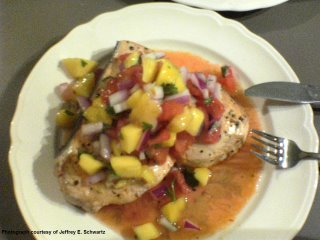
I mention fruit because Jeff recently forwarded me a picture he had taken almost exactly a year ago of the swordfish steaks I’d made one night when we were both still living at 1721 T. It was a good meal, and thoroughly enjoyable. Apart from giving me a rush of nostalgia (it is hard to believe I have spent a year in the District, I guess days – and nights – pass by fast when you spend such a large part of them drinking your face off), the photograph also reminded me of all the fruits that are just now in season. So many fruity dishes to make, so little time. And perhaps more unfortunately, precious few good people to make them for.
Pan Seared Swordfish Steaks in Tomato buerre-blanc with Mango Salsa
2 swordfish steaks
Juice of 1 lemon
Juice of 3 limes
1 tbsp sherry vinegar
Half a handful of cilantro
1 red onion, diced
4 cluster tomatoes, diced
1 large mango, diced
1 cup dry white wine
butter
Salt and pepper the steaks, then drizzle generously with lemon juice and set aside. Meanwhile, whisk the lime juice and sherry vinegar into an emulsion and combine with the red onion, three-quarters of the tomatoes, the mango and the cilantro. Refrigerate the salsa and the steaks for at least two hours. When ready to eat, sear the steaks in a pan on both sides till browned, then add white wine and the remainder of the tomatoes. Cook the liquid down, braising the steaks in the process. When steaks are done, remove and cook sauce down to desired consistency. Monter au buerre and plate the sauce, swordfish and salsa – in that order.

Thursday, March 16, 2006
Party over here!
Last night Laura and Amanda came over for dinner and Amanda spent the better part of two hours making me laugh uncontrollably and of course, laughing uncontrollably herself. It is a wonder I managed to keep my food down. We had a savoury tart - something quite ambitious for me because it is not a technique that I am particularly comfortable with - and a salad that Amanda and I piled heaping mounds of BBQ pulled pork on. For my point is that Laura is vegetarian and always a pain in the butt to cook for (but a lovely one at that); because I usually make meat on the side and I use a different set of utensils and kitchen implements to make the vegetarian portion of the meal - I am dorky like that - and thus end up with a mountain of dishes. Anyway, in summary I made something that I'd never made before and it actually turned out pretty well, so here is the recipe.
Caramelized onion and butternut squash triple cheese tart
2 red onions
1 butternut squash
fresh sage, finely chopped
fresh thyme, finely chopped
a small thing of goat cheese
a small thing of fontina
equal amount of gruyere, grated
1 egg, beaten
breadcrumbs
slab of butter
2 store-bought pie crusts
Preheat oven to 375F. Take one pie crust, lay it flat and set aside. Slice squash in two and seed. Drizzle with olive oil and roast in the oven, cut side down, for 40 minutes or until soft. Meanwhile chop onions thinly and cook in butter and half the thyme, over low heat for 35-40 minutes or until glazed. Add butter and/or a teeny bit of red wine if they look like they're drying out. Once the squash is done, scoop it out of the skin and combine with onions, herbs, egg, breadcrumbs and cheese. Mix well and spread into the pie crust. Take the other pie crust that you've laid flat and use it to cover the one with the filling. Bake in oven for 30 minutes or until crust is golden brown. Cool and serve.
It was great served warm but I kept leftovers in the fridge and am going to eat it cold tonight. I can't wait.
Caramelized onion and butternut squash triple cheese tart
2 red onions
1 butternut squash
fresh sage, finely chopped
fresh thyme, finely chopped
a small thing of goat cheese
a small thing of fontina
equal amount of gruyere, grated
1 egg, beaten
breadcrumbs
slab of butter
2 store-bought pie crusts
Preheat oven to 375F. Take one pie crust, lay it flat and set aside. Slice squash in two and seed. Drizzle with olive oil and roast in the oven, cut side down, for 40 minutes or until soft. Meanwhile chop onions thinly and cook in butter and half the thyme, over low heat for 35-40 minutes or until glazed. Add butter and/or a teeny bit of red wine if they look like they're drying out. Once the squash is done, scoop it out of the skin and combine with onions, herbs, egg, breadcrumbs and cheese. Mix well and spread into the pie crust. Take the other pie crust that you've laid flat and use it to cover the one with the filling. Bake in oven for 30 minutes or until crust is golden brown. Cool and serve.
It was great served warm but I kept leftovers in the fridge and am going to eat it cold tonight. I can't wait.
Friday, November 18, 2005
Stuff wrapped in stuff wrapped in stuff
So I made some hors d'oeuvres last night for a dinner party and this particular one got rave reviews. I really did like it myself – I thought the blend of sweet and savoury was excellent - you get hit by the sweetness of the dates and the spiciness of the chimichurri when you first bite into it, which then transitions seamlessly to the flavour of the meat, complemented by the sharpness of the cheese. It is almost as if the flavours know exactly when to make their entrance, and who to make it with - like an elaborately chereographed dance in your mouth. What made it even better was that I had made these hors d’oeuvres for a wine-tasting party, where I got to sample 8 of the finest wines that France, Italy and California had to offer. Among these was an ’81 Haut Brion – a wine as old as I am, and a wine that made music on my tongue. It was, all in all, a wonderful experience. But then again, anything that is stuffed with anything that is stuffed with anything is usually good - which is why I am sure that I will be a huge fan of turducken when I do eventually have the good fortune to try it.
Steak-wrapped dates
15-20 dates, pitted
one 14-16oz cut sirloin
1/3 cup shavings of Manchego (I used Manchego which worked well but I think there has to be some other cheese that would work better. I would not use complicated or strong flavours like goat cheese or blue cheese, but otherwise – the kitchen is your canvas.)
Basic chimichurri:
shitload of olive oil
salt & pepper
garlic, minced
paprika
cayenne
fresh lemon juice
parsley (if you have cilantro, throw a little in there as well, but parsley works best)
red wine vinegar
***note: I am very protective of my chimichurri recipe, which explains the lack of quantities in this recipe and the fact that I have left out my secret ingredient which wild horses could not drag out of me. I am of the opinion that chimichurri is a highly personalised thing – much like ragu is for Italian housewives – and that everyone should have their own way of making it. This basic recipe will serve its purpose.
preheat oven to 325.
To make the chimichurri, take the olive oil and mix in garlic, cayenne, paprika, parsley and cilantro. I do not own a food processor and every time I feel inclined to purchase one, the words of MFK Fisher ring in my mind, “If it is choppable – chop it.” A mortar and pestle, and a simple mixing bowl, will serve you just as well in almost any circumstance. If you have a food processor, go ahead and blend those ingredients – adding salt and pepper to taste. Stir in the lemon juice and red wine vinegar slowly while whisking and you should get a murky emulsion with a deep fiery tang of red from the paprika and red wine. Just looking at this sometimes makes me want to touch myself. Then marinate the meat in the chimichurri, reserving some for a dipping sauce, while you prepare the dates.
Now if you don't have pitted dates clearly you are going to have to do that yourself - a fork or similar facsimile should work fine. Stuff the cheese into the dates and roast in the oven at 325 for roughly ten to fifteen minutes.
While the dates are roasting, sear the steak in a buttered grill pan, to the desired level of charredness. Stick it in the oven to finish off but you should be looking to cook it medium-rare to medium. Once the steak is done, slice into thin strips. Wrap the individual strips of beef around the dates and stick a toothpick through them. Serve with the chimichurri that you have set aside. Do not serve the sauce that you used to marinate the beef – that is simply unsanitary.
So there you go, this one's a keeper.
Steak-wrapped dates
15-20 dates, pitted
one 14-16oz cut sirloin
1/3 cup shavings of Manchego (I used Manchego which worked well but I think there has to be some other cheese that would work better. I would not use complicated or strong flavours like goat cheese or blue cheese, but otherwise – the kitchen is your canvas.)
Basic chimichurri:
shitload of olive oil
salt & pepper
garlic, minced
paprika
cayenne
fresh lemon juice
parsley (if you have cilantro, throw a little in there as well, but parsley works best)
red wine vinegar
***note: I am very protective of my chimichurri recipe, which explains the lack of quantities in this recipe and the fact that I have left out my secret ingredient which wild horses could not drag out of me. I am of the opinion that chimichurri is a highly personalised thing – much like ragu is for Italian housewives – and that everyone should have their own way of making it. This basic recipe will serve its purpose.
preheat oven to 325.
To make the chimichurri, take the olive oil and mix in garlic, cayenne, paprika, parsley and cilantro. I do not own a food processor and every time I feel inclined to purchase one, the words of MFK Fisher ring in my mind, “If it is choppable – chop it.” A mortar and pestle, and a simple mixing bowl, will serve you just as well in almost any circumstance. If you have a food processor, go ahead and blend those ingredients – adding salt and pepper to taste. Stir in the lemon juice and red wine vinegar slowly while whisking and you should get a murky emulsion with a deep fiery tang of red from the paprika and red wine. Just looking at this sometimes makes me want to touch myself. Then marinate the meat in the chimichurri, reserving some for a dipping sauce, while you prepare the dates.
Now if you don't have pitted dates clearly you are going to have to do that yourself - a fork or similar facsimile should work fine. Stuff the cheese into the dates and roast in the oven at 325 for roughly ten to fifteen minutes.
While the dates are roasting, sear the steak in a buttered grill pan, to the desired level of charredness. Stick it in the oven to finish off but you should be looking to cook it medium-rare to medium. Once the steak is done, slice into thin strips. Wrap the individual strips of beef around the dates and stick a toothpick through them. Serve with the chimichurri that you have set aside. Do not serve the sauce that you used to marinate the beef – that is simply unsanitary.
So there you go, this one's a keeper.
Thursday, October 13, 2005
Dining with the enemy
Lately I find myself in quite a peculiar situation to be in; what does one do when the people one finds worthy to cook for do not share your gastronomic inclinations? Whose enjoyment of the meal should you then sacrifice? It is a vexing question indeed, but perhaps one that – from time to time – yields quite pleasant answers.
I had people over for dinner last night and made an entirely vegetarian dinner - because my friend Laura is, sadly, one of the enemy. Yet there is perhaps nothing I will begrudge her – least of all a home-cooked meal prepared to the best of my ability, for she makes me laugh easily and readily and is good people. She once told me a story once about her friend Steve, the movie "So I Married an Axe Murderer" and the size of the human head that had me in stitches for days. She could have had class. She could have been a contender. By the time the year is through I promise I will stuff a sausage in her mouth. (That didn't come out quite right, I fear.)
Saffron Couscous with Pinenuts and Raisins
1.5 cups couscous
2.5 cups chicken broth
pinch of saffron threads
1 red onion, coarsely chopped
1 red pepper, coarsely chopped
1 clove garlic, minced
some chives, coarsely chopped
handful of pinenuts
handful of raisins
big pinch of paprika
pinch of cayenne
pinch of tamarind
.25 stick butter
salt and pepper
Warm the broth and throw in saffron threads; let sit on low heat for at least 15 minutes. Be careful not to let this boil. Meanwhile, toast the pinenuts in a small amount of olive oil, in a large pot till browned. Remove and set aside. Using the same pot and adding more oil, saute the garlic, red onion and red pepper with spices. Cover the pot and let sit for a couple of minutes. Add the saffron broth and bring to a boil. Once mixture is boiling, remove from heat and stir in couscous. Keep fluffing couscous while stirring in butter, then the pinenuts, raisins and chives. Ready to serve once couscous reaches desired consistency. Serves 4.
Tamarind is available in many forms. If you get the dried powder (which I did), this is not as strong as say, the pulp concentrate. Depending on how much saffron you use – for the money you pay for it nobody wants to overpower the saffron - adjust accordingly)
Slow-Roasted Tomatoes Stuffed with Spinach
8 medium-to-large cluster tomatoes
balsamic vinegar
1 bag spinach
1 onion, well chopped
1 clove garlic, minced
breadcrumbs
some heavy cream (not too much)
pinch of thyme
s/p
Preheat oven at 350F. Remove tops from tomatoes, scoop out the pulp and reserve; turning tomatoes upside down on a paper towel to dry. Lay tomatoes out on roasting pan, salt heavily and season with balsamic vinegar and olive oil. Separately, saute garlic and onion, adding thyme and later, the tomato pulp and breadcrumbs. Meanwhile, cook spinach in saucepan of salted, almost-boiling water for 3 minutes until almost wilted. Drain and add spinach to garlic and onion mix. saute for a while more, add cream and cook down a little before removing from heat. Spoon this spinach-cream mixture into the tomatoes and roast uncovered at 250 for two hours. Serves 4.
As tomatoes go out of season, slow-roasting becomes an easy method to extract the fullest flavour from even the most disappointing of tomatoes. Plus, I'm a huge fan of roasting stuff because of the minimal workload - you just stuff it in the oven and go check your email. Do not hold back on the balsamic vinegar for this one. For aesthetic purposes, you can save the tomato tops and replace when serving, for presentation. Or, you can melt some cheese (mozzarella if you're classy, Kraft singles if you're not) on top of the roasted tomatoes, it all sounds good to me. I just served them as is – they looked pretty damn delicious to me, and did not disappoint.
I had people over for dinner last night and made an entirely vegetarian dinner - because my friend Laura is, sadly, one of the enemy. Yet there is perhaps nothing I will begrudge her – least of all a home-cooked meal prepared to the best of my ability, for she makes me laugh easily and readily and is good people. She once told me a story once about her friend Steve, the movie "So I Married an Axe Murderer" and the size of the human head that had me in stitches for days. She could have had class. She could have been a contender. By the time the year is through I promise I will stuff a sausage in her mouth. (That didn't come out quite right, I fear.)
Saffron Couscous with Pinenuts and Raisins
1.5 cups couscous
2.5 cups chicken broth
pinch of saffron threads
1 red onion, coarsely chopped
1 red pepper, coarsely chopped
1 clove garlic, minced
some chives, coarsely chopped
handful of pinenuts
handful of raisins
big pinch of paprika
pinch of cayenne
pinch of tamarind
.25 stick butter
salt and pepper
Warm the broth and throw in saffron threads; let sit on low heat for at least 15 minutes. Be careful not to let this boil. Meanwhile, toast the pinenuts in a small amount of olive oil, in a large pot till browned. Remove and set aside. Using the same pot and adding more oil, saute the garlic, red onion and red pepper with spices. Cover the pot and let sit for a couple of minutes. Add the saffron broth and bring to a boil. Once mixture is boiling, remove from heat and stir in couscous. Keep fluffing couscous while stirring in butter, then the pinenuts, raisins and chives. Ready to serve once couscous reaches desired consistency. Serves 4.
Tamarind is available in many forms. If you get the dried powder (which I did), this is not as strong as say, the pulp concentrate. Depending on how much saffron you use – for the money you pay for it nobody wants to overpower the saffron - adjust accordingly)
Slow-Roasted Tomatoes Stuffed with Spinach
8 medium-to-large cluster tomatoes
balsamic vinegar
1 bag spinach
1 onion, well chopped
1 clove garlic, minced
breadcrumbs
some heavy cream (not too much)
pinch of thyme
s/p
Preheat oven at 350F. Remove tops from tomatoes, scoop out the pulp and reserve; turning tomatoes upside down on a paper towel to dry. Lay tomatoes out on roasting pan, salt heavily and season with balsamic vinegar and olive oil. Separately, saute garlic and onion, adding thyme and later, the tomato pulp and breadcrumbs. Meanwhile, cook spinach in saucepan of salted, almost-boiling water for 3 minutes until almost wilted. Drain and add spinach to garlic and onion mix. saute for a while more, add cream and cook down a little before removing from heat. Spoon this spinach-cream mixture into the tomatoes and roast uncovered at 250 for two hours. Serves 4.
As tomatoes go out of season, slow-roasting becomes an easy method to extract the fullest flavour from even the most disappointing of tomatoes. Plus, I'm a huge fan of roasting stuff because of the minimal workload - you just stuff it in the oven and go check your email. Do not hold back on the balsamic vinegar for this one. For aesthetic purposes, you can save the tomato tops and replace when serving, for presentation. Or, you can melt some cheese (mozzarella if you're classy, Kraft singles if you're not) on top of the roasted tomatoes, it all sounds good to me. I just served them as is – they looked pretty damn delicious to me, and did not disappoint.
Subscribe to:
Posts (Atom)


 Posts
Posts


